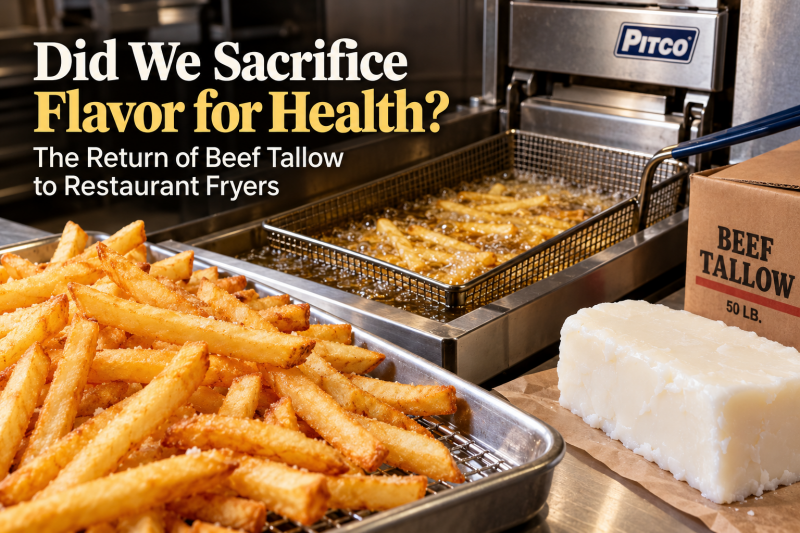
Did We Sacrifice Flavor for Health? The Return of Beef Tallow to Restaurant Fryers
By Phil Moricone | PDM Hospitality Solutions
Back in the late 1980s, I was managing a fast-food operation when the industry began moving away from beef tallow for frying. I remember the change and the growing concern about saturated fats, cholesterol, and healthier cooking oils.
For years, beef tallow had been a popular choice for frying French fries. It delivered excellent flavor, a crispy exterior, and a product customers loved.
Then the industry changed.
In 1990, McDonald's famously moved away from its beef-tallow-based frying blend in the United States. Other restaurant operations were making similar changes as health concerns and consumer expectations influenced the industry.
But looking back, I have to ask: Did we sacrifice flavor in the name of healthier eating?
Let's Talk About French Fries
When customers order French fries, are they really looking for a health food?
I don't think so.
They're looking for delicious, golden-brown, crispy French fries with great flavor. Something that makes them want to come back.
As a chef, restaurant operator, and foodservice equipment specialist, I've always believed that food quality and customer satisfaction should be at the center of restaurant decisions.
That doesn't mean we should ignore nutrition. Beef tallow contains considerably more saturated fat than many modern vegetable frying oils, and reducing saturated fat remains an important heart-health recommendation.
But restaurants also need to recognize what customers expect from the foods they order.
What About the Cost?
I recently compared the prices of beef tallow and a popular commercial frying oil, Mel-Fry.
Product
Case Price
Cost Per Pound
Beef Tallow
$96.00 / 50 lb
$1.92
Mel-Fry
$63.00 / 35 lb
$1.80
That's a difference of just 12 cents per pound.
Consider a commercial gas fryer holding 35 pounds of frying fat.
- Beef tallow: $67.20
- Mel-Fry: $63.00
- Additional cost for tallow: $4.20
For an additional $4.20 per fryer fill, could you produce a better-tasting French fry?
That's a question worth asking.
Beef Tallow May Actually Cost Less in the Long Run
Here's something many restaurant operators may overlook.
Beef tallow can have a longer usable frying life than some conventional vegetable oils.
Because beef tallow contains relatively little polyunsaturated fat, it can resist oxidation during repeated high-temperature frying. Under the right conditions, that may mean fewer oil changes and lower overall frying costs.
However, today's premium commercial frying oils, including specially formulated products such as Mel-Fry, are designed for extended frying life. There is no guarantee that beef tallow will outlast every commercial frying oil.
But consider the economics.
At the prices we've discussed, beef tallow costs only about 6.7% more per pound. That means it needs to last only about 6.7% longer to offset its higher purchase price, assuming comparable oil usage and maintenance.
If Mel-Fry lasted seven days, beef tallow would need to last approximately seven and a half days to break even.
Imagine getting better flavor, fewer oil changes, and potentially lower overall frying costs.
That's certainly worth investigating.
Of course, proper filtering, frying temperatures, food volume, and regular oil-quality testing are essential regardless of which frying fat you choose.
The Health Question
There's an interesting bit of history here.
When restaurants moved away from animal fats decades ago, some switched to partially hydrogenated vegetable oils containing artificial trans fats. Those trans fats were later recognized as a serious health concern and largely eliminated from the American food supply.
Today's vegetable frying oils are different, and many offer a healthier fatty-acid profile than beef tallow.
But let's be realistic. We're talking about fried foods, not steamed vegetables.
Customers should have nutritional information available to make informed choices. At the same time, restaurants shouldn't overlook flavor, freshness, and overall product quality.
Maybe It's Time to Reconsider Beef Tallow
I'm not suggesting every restaurant should immediately drain its fryers and switch to beef tallow.
But I am suggesting that restaurant operators take another look.
Conduct a side-by-side comparison. Fry the same fresh-cut potatoes in beef tallow and your current frying oil. Evaluate flavor, texture, appearance, customer preference, oil life, and actual operating cost.
Let the results help make the decision.
And remember, beef tallow is an animal product. Restaurants need to communicate its use to customers who avoid beef for dietary, religious, or personal reasons.
My Final Thought
Over the years, I've watched the restaurant industry make countless changes in equipment, ingredients, preparation methods, and cooking techniques.
Some have been tremendous improvements. Others deserve a second look.
If a restaurant can produce a noticeably better French fry for only $4.20 more per fryer fill, and potentially save money through longer frying life, shouldn't that possibility be worth exploring?
Customers remember great food. They talk about it, recommend it, and come back for it.
And sometimes, improving your menu doesn't require inventing something new.
Sometimes it means taking another look at something we did years ago.
PDM Hospitality Solutions
Experience. Knowledge. Solutions.