Filtering Fryer Oil Doesn't Have to Be Expensive
One thing I want to make perfectly clear: You don't need to spend thousands of dollars to establish a fryer oil filtering program.
For a small operation, you may already have almost everything you need.
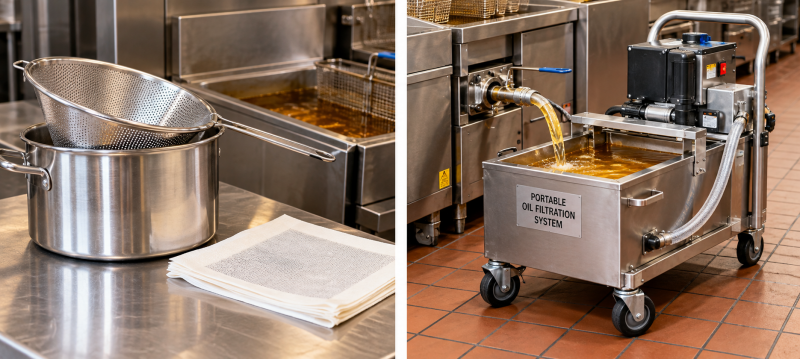
A stainless steel china cap, a proper fryer oil filter, and a suitable metal container may be all the basic equipment you need.
Most restaurant kitchens already have a china cap and stainless steel pots. Often, the only thing missing is the filtering material.
Of course, the equipment must be rated for the oil temperature and volume, and employees must follow safe handling procedures. Hot fryer oil can cause serious burns. A china cap and pot should only be used as part of a safe, manufacturer-approved filtering procedure, with oil cooled to an appropriate handling temperature.
What About Larger Operations?
If your kitchen operates several fryers, you should seriously consider purchasing a portable filtration unit.
These mobile systems can be moved between fryers, making the filtering process faster, cleaner, and more efficient.
They also reduce the amount of manual handling required.
Think about the labor savings alone.
Instead of employees struggling with pots, filters, and oil transfers, a properly designed portable unit can simplify the entire process.
Building a New Restaurant? Buying New Fryers?
Here's something I would strongly recommend.
Consider fryers with built-in oil filtration systems.
Yes, they cost more initially.
But don't make your equipment purchasing decisions based entirely on the purchase price.
Look at the total cost of ownership.
A built-in filtration system can make filtering so convenient that employees are much more likely to perform the task regularly.
That means cleaner oil, more consistent food quality, reduced labor requirements, and potentially longer oil life.
Depending on oil usage, equipment cost, and how much longer the oil lasts, the savings can offset the additional investment surprisingly quickly.
In a busy operation, the return can be substantial.
Think Beyond the Purchase Price
I've spent many years working with commercial kitchen equipment, and one thing I've always tried to impress upon operators is this:
The least expensive piece of equipment isn't necessarily the least expensive piece of equipment to own.
A fryer that costs more initially but reduces oil consumption and labor costs may ultimately be the better investment.
Whether you're operating a small neighborhood restaurant with one fryer or a busy kitchen with six, there is a filtration solution worth considering.
The important thing is to establish a system and actually use it.
Because filtering fryer oil isn't an unnecessary expense. It's an investment in food quality and profitability.