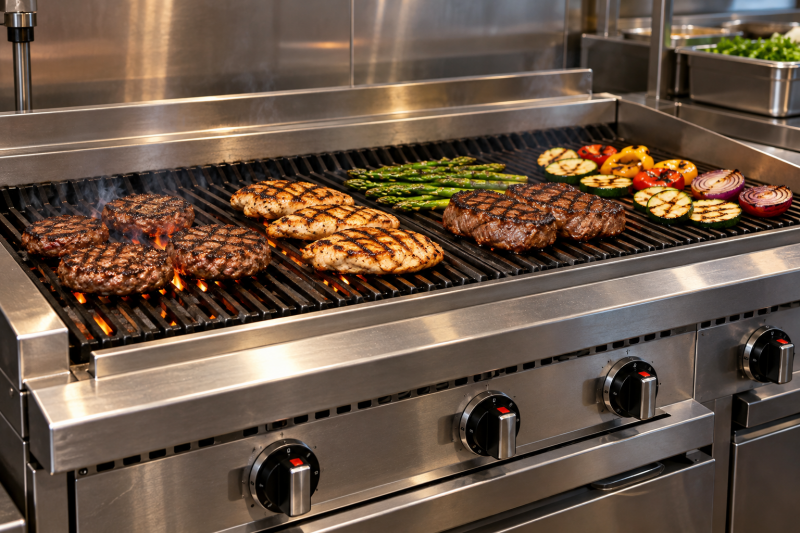
Understanding Charbroilers and the Differences
There are 3 basic types of charbroiler in a kitchen application. Radiant, Lava Rock and Infrared. What's the difference and what do you need ?
Radiant Charbroilers
The burners heat metal radiants below the cooking grates. The radiants distribute the heat and protect the burners from dripping. Typically very easy to clean. However in time radiants need replacement.
Lava Rock Char Broilers
Gas Burners heat a bed of lava rocks. Dripping hit the lava rocks and create smoke. It seems more like traditional charbroiled. The advantage is more grilled flavor. Trade off is lava rocks need replacement in time. However, flipping them over at times will prolong life. The main disadvantage this broiler will have is the most flare ups. Not a god idea for small kitchens and food trucks .
Infra-Red Charbroiler
The burner heats an emitter that directs radiant energy toward the grates.
Biggest advantage: they produce more heat than the others and offer excellent searing capabilities. They can also use less gas and operate at 92% efficiency. Lava Rock and Radiant Charebroilers run about 50% efficient. The initial investment in Infra-Red is very expensive and replacement parts can be costly.
BTU’s - What the ratings actually tell you
Commercial gas Charbroilers ratings are expressed in BTU’s. A higher BTU rating does not mean hotter or faster cooking. You need to consider the size of the unit and how many burners
Example
Take 2ea 48 inch char broilers @ 120 BTUs
The first broiler has 4 burners that operate at 30k BTUs
The second broiler has 8 burners that operate @ 15k BTUs
It’s hard to determine which one will cook aster. However in a busy steak house where there would be varied menu items the 8 burner would offer better control. You would have control with 4 burners but over a wider area.
PDM Hospitality Solutions