The Cook & Hold Oven: One of the Most Underrated Pieces of Equipment in a Commercial Kitchen
PDM Hospitality Solutions
Systems • Solutions • Training
Better Food, Less Shrinkage, Greater Versatility, and More Profit
Over my many years in the foodservice industry, I've worked with just about every type of commercial cooking equipment imaginable.
But if you asked me to name one of my all-time favorite pieces of equipment, the Cook & Hold oven would be near the top of my list.
Why?
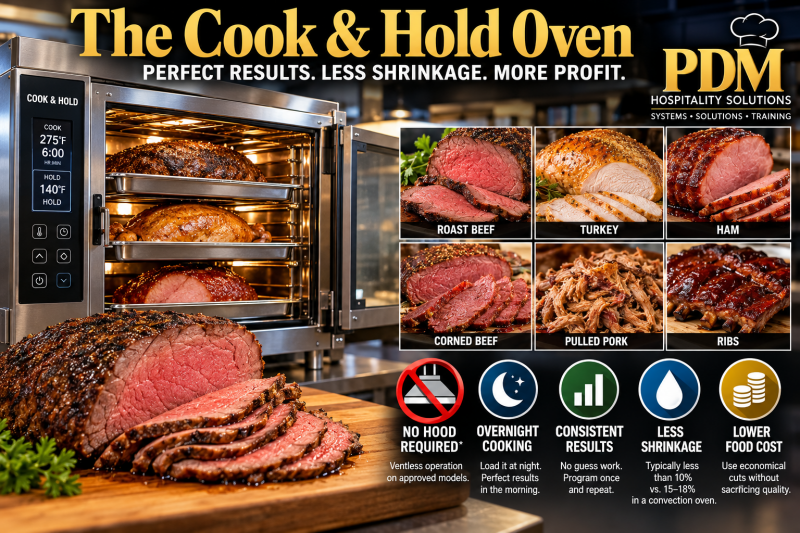
Because this remarkable piece of equipment can transform economical cuts of meat into tender, juicy, consistently cooked products while dramatically reducing shrinkage.
And it does much more than prepare outstanding roast beef.
From turkey and ham to corned beef, pulled pork, and ribs, the Cook & Hold oven is one of the most versatile pieces of equipment a commercial kitchen can own.
What Makes a Cook & Hold Oven Different?
Unlike a traditional convection oven, which circulates hot air around the food, a Cook & Hold oven generally uses gentle, controlled heat with minimal air movement.
The process involves two stages.
The Cooking Cycle: The meat is slowly brought to its desired internal temperature using controlled heat.
The Holding Cycle: The oven automatically transitions to a lower holding temperature, allowing the product to remain hot without continuing to cook as aggressively.
This controlled process helps retain moisture, improve consistency, and reduce shrinkage.
The Science Behind Tenderization During Holding
I've noticed something interesting over the years when preparing roast beef in a Cook & Hold oven.
Certain cuts become remarkably tender through the combination of slow cooking and extended holding.
I've often described the effect this way:
"Every hour in the holding cycle seems like another day of aging."
Scientifically, the two processes are different, but the comparison describes the tenderness I've experienced.
Beef contains muscle fibers, connective tissue, and collagen.
During slow cooking, heat gradually changes the structure of connective tissue. With sufficient time and temperature, some collagen converts into gelatin, contributing to tenderness.
At a holding temperature of approximately 140°F, that conversion is relatively slow. Much of the tenderness develops during the cooking stage, while the holding cycle can help maintain the desired eating quality.
This is why understanding both cooking temperature and holding time is so important.
Why I Prefer Economical Cuts of Beef
One of the greatest advantages I've found with Cook & Hold cooking is that I don't always need to purchase expensive cuts of beef to produce outstanding results.
I've had excellent results using economical cuts such as top round.
I also don't necessarily need to spend additional money purchasing extensively dry-aged or wet-aged beef.
Although aging and slow cooking tenderize meat through different processes, the Cook & Hold oven can produce excellent eating quality from properly selected, less expensive cuts.
For restaurant operators, that's an opportunity to improve food cost without sacrificing quality.
Shrinkage: Where the Savings Begin
In my experience, properly operated Cook & Hold ovens can produce roast beef with shrinkage of less than 10%.
Compare that with some conventional or convection-oven roasting methods, where I've experienced shrinkage between 15% and 18%.
Actual results depend on the cut, cooking temperature, final internal temperature, and holding time.
Multiply the saving across hundreds of portions, and the savings can become substantial.
Another Major Advantage: Ventless Installation
Here's an equipment advantage many operators overlook.
Certain commercial Cook & Hold ovens can operate without a traditional Type I exhaust hood.
Depending on the manufacturer's listing, the food being prepared, and local code requirements, these ovens may be approved for installation without the expensive ventilation systems required for many other types of cooking equipment.
That can be a tremendous advantage in kitchens with limited space, existing buildings, catering operations, and smaller foodservice facilities.
However, operators must verify the specific equipment's ventless listing and obtain approval from the local authority having jurisdiction. Not every model or cooking application qualifies.
When permitted, avoiding a traditional exhaust hood can reduce installation complexity and expense.
Overnight Cooking: Let the Equipment Work While You Sleep
Another reason I've always appreciated Cook & Hold ovens is their ability to handle long, controlled cooking cycles.
Many operations can load the oven in the evening, select a validated cooking program, and allow the equipment to complete the cooking cycle overnight.
Once cooking is completed, the oven automatically transitions into its programmed holding cycle.
Imagine arriving at the restaurant in the morning and having properly cooked roast beef, turkey, or pork ready for the day's production.
There's no need to start a large roast first thing in the morning and hope it's ready before lunch service.
Of course, overnight programs must follow approved food-safety procedures, including safe cooking temperatures, holding temperatures, and any required monitoring.
But with the proper procedures in place, overnight cooking can be an enormous production advantage.
No Guesswork: Consistent Results Every Time
One of the greatest challenges in commercial cooking is consistency.
One chef prepares a beautiful roast beef. The next day, another cook produces a roast that's overdone.
A properly programmed Cook & Hold oven can greatly reduce that variability.
With established recipes, temperature probes where appropriate, and validated cooking programs, operators can achieve highly repeatable results.
Once the correct program has been developed for a particular product, the staff can follow the same procedure every time.
Less guesswork. Less waste. Better consistency.
That's exactly what restaurant systems and employee training should accomplish.
It's Not Just for Roast Beef
While roast beef is one of my favorite applications, the Cook & Hold oven is capable of producing outstanding results with many other proteins.
Turkey: Gentle roasting helps retain moisture, particularly in breast meat, which can dry out quickly in conventional ovens.
Ham: Controlled heat provides even warming or cooking while helping prevent excessive moisture loss.
Corned Beef: Long, controlled cooking can help soften connective tissue and produce tender, sliceable meat. The cooking program must provide sufficient time and temperature for collagen breakdown.
Pulled Pork: Pork shoulder benefits from extended cooking that converts collagen into gelatin. The result can be moist, tender pork that pulls apart easily.
Pork Ribs: Carefully controlled cooking can produce tender ribs without excessive drying. A separate finishing step can be used when caramelization or a traditional barbecue exterior is desired.
For an operator producing several different proteins throughout the week, this versatility makes the equipment even more valuable.
Labor Savings and Production Planning
Think about what this equipment can accomplish for a busy kitchen.
A restaurant can prepare proteins during scheduled production periods, use properly controlled overnight programs, and have products ready for service with less last-minute cooking pressure.
That can mean better use of employee time, improved scheduling, fewer rushed preparations, and more consistent service.
The Cook & Hold oven doesn't replace a skilled chef.
It gives that chef a dependable tool and a repeatable system.
My Philosophy: Equipment Should Make You Money
I've always believed that restaurant equipment should do more than simply cook food.
It should improve consistency, reduce labor demands, minimize waste, and contribute to profitability.
The Cook & Hold oven checks many of those boxes.
It can deliver outstanding roast beef, turkey, ham, corned beef, pulled pork, and ribs while helping control shrinkage and improve finished-product yields.
Add the potential benefits of overnight cooking, automatic holding, and ventless installation where approved, and you have an exceptionally valuable piece of commercial kitchen equipment.
Don't buy equipment simply because it cooks. Buy equipment because it helps your kitchen operate better and your restaurant make more money.
PDM Hospitality Solutions
Systems • Solutions • Training
Real-world restaurant experience. Practical solutions. Better profitability.
Cook