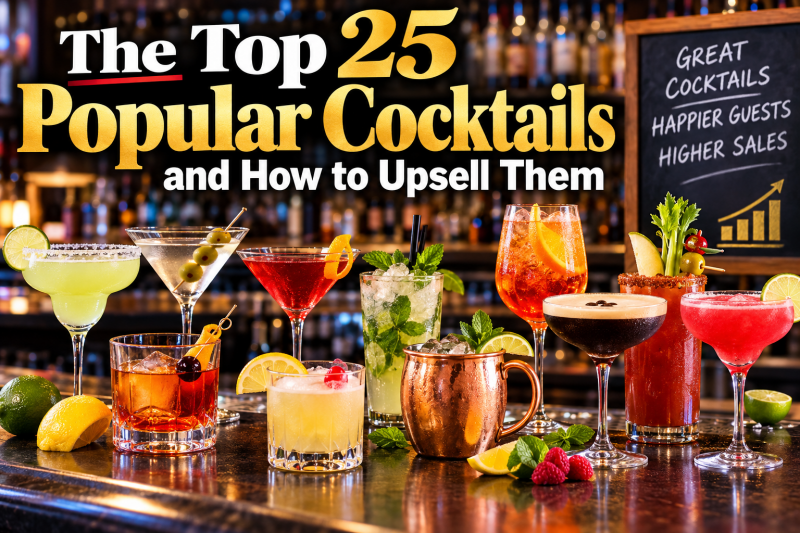
The Art of Upselling Cocktails: 25 Popular Drinks Every Bartender and Server Should Know
By PDM Hospitality Solutions — Restaurant Tips & Profitability
In the restaurant business, I've always believed that your servers and bartenders are more than order takers. They're salespeople. And one of the most overlooked opportunities to increase sales and profitability is right behind the bar.
Think about it. A guest sits down and orders a vodka tonic. The bartender pours a house vodka, adds tonic, and charges $9. Transaction complete.
But what if the bartender simply asked, "Do you have a favorite vodka? We have Tito's, Ketel One, and Grey Goose."
The guest might happily choose a premium vodka and spend another $3 or $4. The bartender hasn't worked any harder, and the guest gets exactly what they prefer.
That's upselling. Not pressure. Not trickery. Just giving the guest an opportunity to enjoy something better.
The forgotten art of cocktail salesmanship
Years ago, a good bartender knew how to make a proper Manhattan, Old Fashioned, Sidecar, or Whiskey Sour. They knew their liquors, their garnishes, and how to recommend a cocktail based on a customer's tastes.
Today, too many bartenders simply make whatever is ordered. There's very little conversation about premium spirits, specialty cocktails, or even an after-dinner drink.
That's lost revenue.
A knowledgeable bartender should be able to describe a cocktail in a way that makes someone want to order it.
Instead of saying, "We have margaritas," try:
"Our house margarita is excellent, but we also make a Cadillac Margarita with premium tequila and Grand Marnier."
Now you've created an opportunity.
25 popular cocktails and how to upsell them
These are 25 widely recognized classic and contemporary cocktails worth including in a restaurant's bartender and server training program. They're not presented as a statistically ranked national sales list.
The selections also reflect cocktail trends documented by Drinks International and NielsenIQ.
Drinks International
+2
Cocktail
Upselling opportunity
1. Margarita
Premium 100% agave tequila, fresh lime, or Cadillac upgrade
2. Old Fashioned
Premium bourbon or rye whiskey
3. Martini
Premium gin or vodka, specialty olives
4. Manhattan
Premium rye, bourbon, or upgraded sweet vermouth
5. Espresso Martini
Premium vodka and freshly brewed espresso
6. Negroni
Premium gin or barrel-aged variation
7. Cosmopolitan
Premium citrus vodka and quality orange liqueur
8. Mojito
Aged rum or fresh seasonal fruit
9. Moscow Mule
Premium vodka and quality ginger beer
10. Whiskey Sour
Premium bourbon, fresh lemon, proper foam
11. Daiquiri
Aged rum or premium white rum
12. Paloma
Premium blanco tequila and fresh grapefruit
13. Aperol Spritz
Upgrade to a premium sparkling wine
14. Bloody Mary
Premium vodka and signature garnishes
15. Piña Colada
Premium rum or aged-rum float
16. Long Island Iced Tea
Premium spirits in a properly measured recipe
17. French 75
Champagne instead of standard sparkling wine
18. Amaretto Sour
Premium amaretto and fresh lemon
19. Mai Tai
Premium aged rum blend
20. Gin & Tonic
Premium botanical gin and specialty tonic
21. Tom Collins
Premium gin and fresh lemon
22. Sidecar
Premium Cognac and quality orange liqueur
23. Lemon Drop Martini
Premium citrus vodka and fresh lemon
24. White Russian
Premium vodka and quality coffee liqueur
25. Irish Coffee
Premium Irish whiskey, fresh coffee, lightly whipped cream
The dollars add up quickly
Consider a restaurant serving 100 cocktails a day.
Illustrative daily upselling opportunity
Daily cocktails
100
Customers upgrading
30%
Additional selling price per upgrade
2345
Daily
$90
Weekly (7 days)
$630
Annual (365 days)
$32,850
Additional gross sales, not profit. Ingredient costs, operating days, and actual customer acceptance will affect results.
That's potentially thousands of dollars in additional annual revenue simply by training employees to offer a better product.
But there's one important rule: Never assume the premium drink is automatically more profitable. Calculate the additional ingredient cost and compare the contribution margin.
Five things I would teach every bartender and server
- Know your spirits. Understand the difference between bourbon and rye, blanco and añejo tequila, and house and premium vodka.
- Ask the right question. Instead of "What do you want to drink?" try "Do you prefer gin or vodka in your martini?"
- Sell quality, not quantity. A premium spirit is an upgrade. Pouring more liquor without charging appropriately is not.
- Learn how to describe a cocktail. "Fresh lime, premium tequila, and a touch of orange liqueur" sounds more appealing than "Margarita."
- Never forget the second opportunity. A guest enjoying dinner may be interested in an Espresso Martini, Irish Coffee, or a cordial afterward.
Don't overlook after-dinner cocktails
One of my biggest complaints about today's restaurant industry is how little attention is given to after-dinner drinks.
Years ago, a server would return after clearing dinner plates and offer coffee, dessert, and perhaps a cordial or specialty coffee drink.
What happened to that tradition?
An Irish Coffee, Jamaican Coffee, Brandy Alexander, Espresso Martini, or a simple glass of amaretto can be an excellent way to finish a meal.
And for the restaurant, these drinks can provide attractive contribution margins when properly priced and portioned.
A server should never rush the guest, but there's nothing wrong with asking:
"Would anyone care for an Espresso Martini or Irish Coffee to finish the evening?"
That's hospitality and salesmanship working together.
My final thoughts
After more than 50 years in the foodservice industry, I still believe some of the best ways to improve profitability are the simplest.
You don't always need a new menu, an expensive advertising campaign, or additional customers.
Sometimes the opportunity is already sitting at your bar or dining room table.
Train your people. Teach them the products. Give them the confidence to make recommendations.
And most importantly, make sure they understand that great upselling improves the guest experience while increasing restaurant profitability.
A good bartender makes a drink.
A great bartender knows how to sell the experience.
PDM Hospitality Solutions
Hospitality • Systems • Solutions • Training
This article would fit well under Restaurant Tips → Bar & Beverage Profitability on your Webador website. It could also become a practical bartender training handout, with the 25 cocktails and suggested selling points on a separate page.