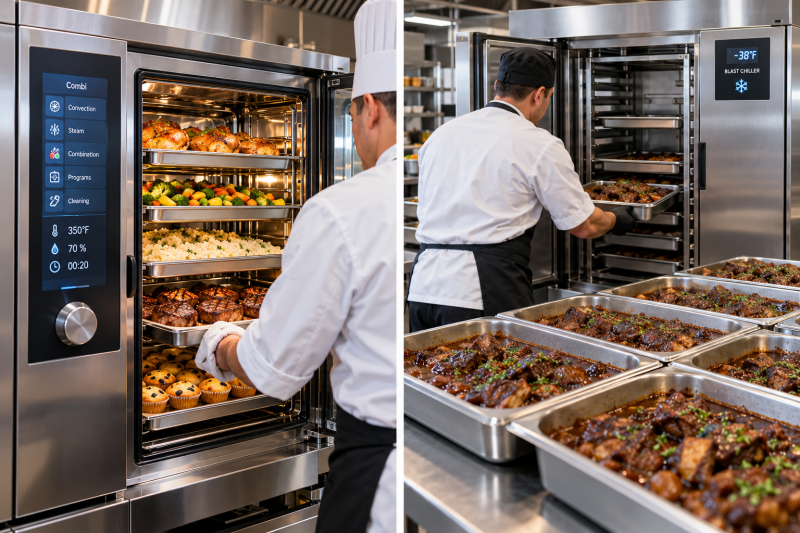
Cook Today, Serve Tomorrow: How Cook-Chill-Retherm Can Transform Your Kitchen
Reduce repetitive labor, improve consistency, protect food quality, and take control of your production schedule.
I've spent years working in restaurant kitchens, catering operations, and the commercial foodservice equipment industry. One thing I've learned is that many kitchens make their jobs much harder than necessary.
They prepare the same foods every day, often during their busiest hours, when employees are already stretched thin.
But what if you could prepare much of your food during slower periods, safely chill it, and bring it back to serving temperature when needed without sacrificing quality?
That's where cook-chill-rethermalization becomes such a powerful production strategy.
A Food Truck Cooking Short Ribs Every Day
I once worked with a food truck operator who was preparing short ribs every single day at his homebase kitchen. .
Think about that. All before hitting the road.
Every day involved preparing the meat, cooking it, cleaning the equipment, and repeating the same labor-intensive process.
I showed them another way.
Why not organize production so they could prepare their short ribs in one planned cooking session, rapidly chill the finished product, and rethermalize portions as needed throughout the week?
Instead of cooking the same product every morning, they could concentrate their preparation into one production day.
That changes everything.
It can reduce repetitive labor, simplify purchasing, improve consistency, and allow employees to concentrate on serving customers rather than continually preparing the same food.
Naturally, production quantities, storage life, cooling procedures, and food-safety requirements must be carefully planned. A week's production may require freezing some portions rather than relying entirely on refrigerated storage.
Reheating Makes Leftovers. Rethermalizing Makes a Fresh Meal.
There's an important distinction I like to make.
When most people think of reheating food, they imagine yesterday's leftovers being placed in a microwave or hot oven.
That's not what I'm talking about. When food is rethermed correctly it is brought back to its original intended temperature and quality.
Professional rethermalization is a planned process.
Food is prepared using appropriate cooking procedures, rapidly chilled, stored correctly, and returned to serving temperature using a carefully developed program.
With suitable equipment, you can control temperature, moisture, airflow, and cooking time to protect the quality of the finished product.
The goal is for the customer to receive a meal that looks, tastes, and eats like it was freshly prepared.
Rethermalization is technically a form of reheating, but a properly designed process focuses on restoring the original product's quality rather than simply making it hot.
The Equipment Works as a Team
Imagine combining four pieces of equipment:
Combi Oven: Provides versatile, programmable cooking and controlled rethermalization.
Cook & Hold Oven: Allows gentle cooking of products such as prime rib and other roasts, followed by controlled hot holding.
Blast Chiller: Rapidly reduces food temperature so properly prepared products can move safely into refrigerated or frozen storage.
Holding Cabinet: Maintains appropriate serving temperatures for foods that are ready for service.
Each piece serves a different purpose.
Together, they can create an efficient production system that allows food to be prepared during slower periods rather than requiring everything to be cooked during the busiest hours.
A Refrigerator Is Not a Substitute for Proper Cooling Equipment
This is one of the most important things restaurant operators need to understand.
You cannot simply prepare large quantities of hot food, place them in a walk-in refrigerator, and assume they will cool safely.
Imagine preparing 14 hotel pans of rice or several large pans of short ribs.
You finish cooking, place the hot pans in your walk-in refrigerator, close the door, and assume everything is fine.
But what's actually happening?
The outside of the food begins cooling while the center of a deep pan may remain dangerously warm for hours. Meanwhile, the hot food adds a substantial heat load to the refrigerator, potentially raising the temperature of other products stored nearby.
A walk-in refrigerator is primarily designed to maintain cold food at safe temperatures. It is not necessarily designed to rapidly cool large quantities of hot food.
Under the FDA Food Code, most cooked foods requiring time and temperature control for safety must be cooled:
- From 135°F to 70°F within two hours.
- From 135°F to 41°F or below within a total of six hours.
These requirements must be verified with actual food temperatures, not assumptions about the refrigerator setting.
Small quantities may be cooled safely using shallow pans, ice baths, rapid-cooling equipment, or other approved methods when properly managed.
But for a restaurant, hotel, caterer, or food truck planning substantial batch production, a properly sized blast chiller can be one of the most important equipment investments.
A blast chiller is designed to remove heat from cooked food rapidly through powerful refrigeration and controlled airflow.
The difference is significant.
A conventional refrigerator maintains cold food. A blast chiller is specifically engineered to bring hot food down to safe storage temperatures quickly.
And that is what makes a planned cook-chill-retherm production system practical.
You can have the best combi oven in the world, but without a safe and effective cooling process, you don't have a complete cook-chill system.
Imagine a Banquet for 300 Guests
Let's say you're preparing filet mignon for 300 people.
In a traditional kitchen, that can create tremendous pressure at service time.
Multiple cooks may be working over charbroilers, trying to prepare hundreds of steaks consistently while coordinating potatoes, vegetables, sauces, and plating.
Now consider a planned production approach.
The filets can be grill-marked for presentation, arranged on sheet pans, and cooked in a combi oven using a tested cooking program.
Core-temperature probes help monitor doneness, although multiple portions must be checked to confirm consistent results.
If the steaks are properly cooked ahead of time, they can be rapidly chilled, properly stored, and rethermalized for service using a validated procedure.
The goal is to shift as much production as practical away from the last-minute rush. Often prepared the day or days before. .
But when the system is properly designed, large-volume service becomes much more manageable.
Better Cooking Procedures Can Improve Yields
Food cost isn't simply about what you pay for ingredients.
It's also about how much finished product you get from those ingredients.
Consider a large roast or an expensive cut of beef.
Excessive cooking temperatures, poor temperature control, and improper holding can cause unnecessary moisture loss and shrinkage.
Gentle, controlled cooking can improve finished yield.
Even a small yield improvement can mean significant savings when you're preparing large quantities of expensive proteins.
And when products are portioned consistently, you have another opportunity to control costs.
Labor Savings Go Beyond the Cooking Process
Consider the repetitive tasks involved in preparing the same menu item every day.
Employees gather ingredients, prepare the product, set up equipment, cook, monitor, transfer food, and clean up.
Tomorrow, they repeat the process.
Batch production can reduce the number of times these tasks must be performed.
It can also help operators schedule more preparation during slower periods, when equipment and employees are available.
That doesn't mean eliminating skilled cooks.
It means using their time more effectively.
A chef can establish recipes, production standards, portion sizes, and cooking programs while the equipment helps the operation reproduce those standards.
What About Food Left at the End of the Day?
This is another area where good planning matters.
Properly cooked food that has been safely hot-held and remains eligible for reuse may be rapidly chilled and stored for later service, subject to applicable food-safety rules.
But not everything should be saved.
Food that has been improperly held, contaminated, served to customers, or kept outside safe temperature limits cannot simply be rescued by a blast chiller.
The objective is to prevent waste through planned production, not to find ways to reuse unsafe food.
A good cook-chill system starts with correct handling procedures and documented temperature controls.
Food Safety Is Essential
Cook-chill production requires more than purchasing a blast chiller.
Operators need written procedures for cooking, rapid cooling, storage, date marking, reheating, and hot holding.
As a general example, the FDA Food Code specifies a two-stage cooling process for many cooked time/temperature-control-for-safety foods: from 135°F to 70°F within two hours, and from 135°F to 41°F or below within a total of six hours.
For many foods cooked, cooled, and reheated for hot holding, the Food Code generally requires reheating to 165°F for 15 seconds within two hours, with specific exceptions. A combi with a temperature probe can be set to 165 to avoid any additional cook time and temp. This will produce a better consistent product.
Food quality and food safety must work together.
Not Just for Large Hotels and Caterers
One of the biggest misconceptions is that cook-chill-retherm systems are only practical for large banquet operations.
Think about the food truck preparing short ribs every day.
A small restaurant might batch-produce soups, sauces, braised meats, or other suitable menu items.
A catering company could prepare much of its menu before an event. Often preparation can be done day or days earlier.
A hotel could coordinate banquet production without requiring every item to be cooked at the last minute.
A busy restaurant could shift some preparation away from its peak dinner hours.
The equipment and process should be scaled to the business.
The Real Return on Investment
When considering a combi oven, blast chiller, or Cook & Hold oven, operators often focus on the purchase price.
That's understandable. This equipment can represent a significant investment.
But purchase price is only part of the equation.
Ask yourself:
- How much labor could be saved by eliminating repetitive production?
- Could more food be prepared during slower periods?
- Would better cooking controls improve finished yields?
- Could portion consistency reduce waste?
- Could the kitchen handle larger functions without dramatically increasing staffing?
- Would improved scheduling reduce pressure during busy service?
Those are the questions that determine whether an equipment investment makes financial sense.
Not every operation needs all four pieces of equipment. The right system depends on menu requirements, production volume, available space, and the financial return.
My Final Thought
I've always believed that successful restaurant operations aren't necessarily the ones with the most expensive equipment.
They're the ones that understand how to use their equipment effectively.
My experience with the food truck preparing short ribs every day is a perfect example.
The solution wasn't a new recipe or a bigger kitchen.
It was a better production method.
Cook when it makes sense. Chill safely. Rethermalize properly. Serve a quality meal.
When those steps are planned and executed correctly, you can reduce unnecessary labor, improve consistency, and create a more efficient kitchen.
That's what smart foodservice operations are all about.
PDM Hospitality Solutions
Practical experience. Better equipment decisions. Smarter foodservice operations