Fresh-Cut French Fries: Are They Really Worth the Extra Work?
PDM Hospitality Solutions | Systems • Solutions • Training
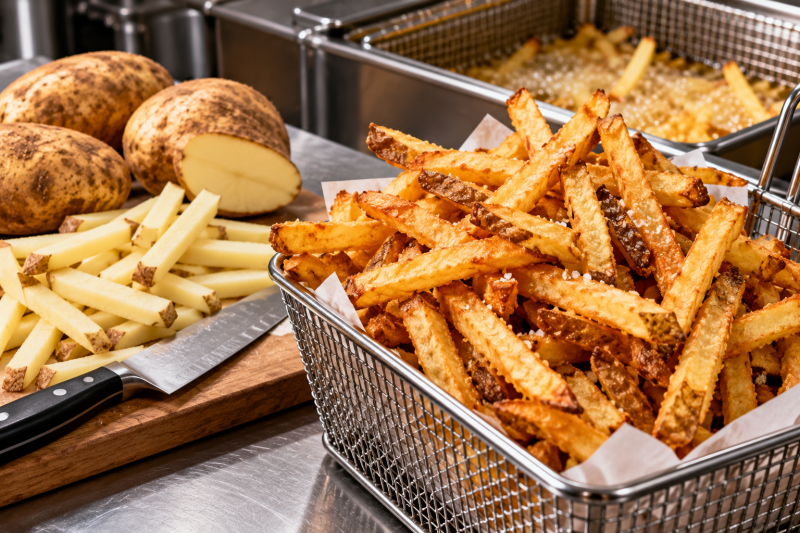
There is something special about a great order of fresh-cut French fries. Golden brown, crispy on the outside, tender on the inside, and served hot with just the right amount of salt.
Many restaurants advertise fresh-cut fries as a point of difference. But are they really better than frozen fries? More importantly, are they more profitable?
The answer depends on how you prepare them, what they cost, and whether your customers recognize the difference.
It Starts with the Potato
Not every potato makes a great French fry.
High-starch potatoes, particularly Russet varieties, are generally preferred for traditional French fries. They have the characteristics needed to produce a fluffy interior and crispy exterior.
But the potato itself is only the beginning.
Potato size, sugar content, storage conditions, and moisture all influence the finished product. Potatoes with excessive sugar can brown too quickly, producing dark fries before the inside is properly cooked.
Consistency begins long before the potato reaches the fryer.
Cutting Fresh Fries Is Only One Step
A restaurant making fresh-cut fries needs a process that every employee can follow.
1. Inspect and wash the potatoes.
Remove damaged potatoes, wash thoroughly, and decide whether the operation will serve skin-on or peeled fries.
2. Cut uniformly.
A commercial French fry cutter produces a consistent cut and reduces labor. Whether the restaurant chooses 1/4-inch shoestring fries, 3/8-inch regular fries, or thick steak fries, uniformity is essential.
Uneven fries cook unevenly.
3. Rinse away surface starch.
Rinsing freshly cut potatoes removes excess surface starch and helps prevent the fries from sticking together.
Some operations also soak their cut potatoes in cold water. The method and soaking time should be standardized rather than left to individual employees.
4. Blanch the fries.
For a traditional double-fried French fry, the first cooking stage is performed at a lower temperature, commonly around 300–325°F.
The objective is to cook the interior without developing excessive color.
The exact time depends on the thickness of the cut, potato variety, and equipment.
5. Cool properly.
After blanching, fries need to drain and cool. If they are being prepared in advance, they must be cooled promptly and refrigerated under a food-safety procedure appropriate for the operation.
6. Finish frying to order.
The final fry is generally performed at a higher temperature, often around 350–375°F, until the fries are golden and crisp.
Drain, season immediately, and serve.
A great French fry doesn't improve while sitting under a heat lamp.
What About the Labor?
This is where the decision becomes interesting.
Fresh-cut fries require purchasing, storage, washing, cutting, rinsing, blanching, cooling, handling, and additional cleanup.
Frozen fries eliminate much of that work.
Consider an employee who spends two hours preparing potatoes. That time has a cost, even if the employee is already on the clock.
Could those two hours have been spent preparing another menu item, improving kitchen readiness, or reducing overtime?
Labor must be included when evaluating the true cost of fresh-cut fries.
Let's Talk About Food Cost
Suppose a restaurant purchases 100 pounds of potatoes for $45.
That sounds inexpensive compared with a case of frozen fries.
But after trimming and processing, the usable quantity may be lower. Add labor, oil, utilities, and waste, and the savings can disappear.
Frozen fries typically cost more per purchased pound but provide predictable portions, consistent quality, and much less preparation labor.
The number that matters isn't the price per pound purchased. It's the total cost per sellable portion.
That includes the cost of getting the product onto the customer's plate.
Fresh-Cut Fries Can Be a Marketing Advantage
Now consider the other side of the equation.
A restaurant that makes outstanding fresh-cut fries has something worth promoting.
Fresh-Cut Daily.
House-Cut Russet Fries.
Twice-Cooked Fresh French Fries.
These descriptions communicate something different from ordinary fries.
If customers appreciate the quality, the restaurant may be able to charge a premium.
An additional dollar per order can make a significant difference when selling hundreds of orders each week.
But the quality must justify the price.
A poorly prepared fresh-cut fry is not better than an excellent frozen fry simply because someone cut the potato in-house.
Don't Overlook the Equipment
Fresh-cut fries require more than a knife and a fryer.
A high-volume operation may need a commercial fry cutter, appropriate prep sinks, draining racks, refrigerated storage, blanching capacity, and adequate fryer recovery.
Fryer capacity is particularly important.
Adding cold potatoes or overloading the fryer can cause oil temperature to drop, affecting texture and cooking time.
A busy restaurant cannot afford to have its French fry program slow down the entire kitchen.
The Final Decision
There is no universal winner between fresh-cut and frozen French fries.
A small restaurant with available prep labor, the right equipment, and customers who appreciate house-made food may benefit from fresh-cut fries.
A high-volume operation requiring speed, consistency, and minimal preparation may find that a premium frozen fry is the better business decision.
My recommendation is simple.
Test both products.
Calculate the true finished cost per portion. Compare preparation time, cooking performance, waste, and customer response.
Then ask one final question:
Will the customer recognize and pay for the difference?
Fresh-cut fries can be an excellent menu feature. But like every menu decision, they must make sense operationally and financially.
At PDM Hospitality Solutions, we believe great food and sound operating systems should work together—not compete with each other.
PDM Hospitality Solutions
Systems • Solutions • Training
PDMhospitalitysolutions.com