The Art of the Twist: Are Bartenders Getting It Wrong?
PDM Hospitality Solutions
Systems • Solutions • Training
Sometimes the smallest details make the biggest difference.
After decades in the hospitality industry, I've noticed something behind the bar that continues to surprise me. It's a simple technique that many bartenders perform without ever questioning why they're doing it.
I'm talking about the lemon twist.
Order a martini, a Manhattan with a requested lemon twist, or another classic cocktail that calls for citrus, and watch what happens.
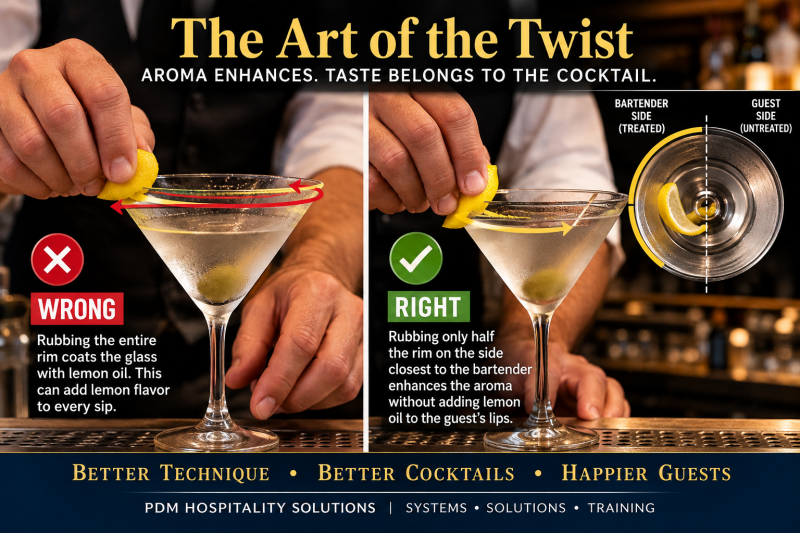
The bartender cuts a lemon twist, expresses the oils, and then proceeds to rub that lemon peel around the entire rim of the glass.
But here's my question: Why are we coating the entire rim with lemon oil when the primary purpose of the twist is to enhance the cocktail's aroma?
Aroma vs. Taste: Understanding the Difference
A properly prepared lemon twist releases aromatic oils from the peel. Those oils contain compounds that contribute to the wonderful, fresh citrus fragrance we associate with a well-made cocktail.
Our sense of smell plays an enormous role in how we experience flavor. Before the cocktail ever touches our lips, our nose is already telling our brain what to expect.
That's part of the magic of a properly prepared martini.
But when a bartender rubs lemon peel around the entire rim, every sip potentially introduces lemon oil directly to the guest's lips.
Now we've gone beyond enhancing aroma. We've deliberately added another element to the taste experience.
That may be desirable for some cocktails and some guests, but is it always necessary?
I don't believe so.
My Approach: Only Half the Rim
Here's a simple technique I believe deserves more attention.
When preparing a martini or another cocktail where the lemon twist is intended primarily for aroma, I prefer to treat only one portion of the rim.
The technique is simple:
- Prepare the cocktail according to the recipe.
- Cut a fresh lemon twist, avoiding excessive white pith.
- Gently express the lemon oils over the surface of the drink.
- Lightly rub the peel along approximately half the glass rim, on the side closest to the bartender.
- Present the glass so the treated portion faces away from the guest, leaving the untreated rim as the natural drinking side.
The result?
The guest can enjoy the wonderful citrus aroma without necessarily having lemon oil transferred directly to their lips with every sip.
We're allowing the nose to experience the lemon while preserving more of the cocktail's intended taste.
The Importance of Presentation
This is where professional bartending becomes more than simply mixing ingredients.
How we present a cocktail matters.
The position of the glass, the placement of the garnish, and even which side of the rim faces the guest can influence the drinking experience.
Of course, a guest can rotate the glass, and the expressed oils on the drink's surface will still contribute to flavor. But the point is intentional technique.
A professional bartender should understand not only how to perform a step, but why that step is being performed.
Tradition Should Never Replace Understanding
I'm not suggesting that rubbing the entire rim is always wrong. Some guests enjoy a pronounced citrus character, and certain cocktails benefit from it.
What I am suggesting is that bartenders should stop treating every garnish technique as an automatic routine.
A lemon twist isn't simply decoration. It's an aromatic ingredient that should be used with purpose.
There is a difference between enhancing a cocktail and changing its character.
The PDM Hospitality Perspective
Great hospitality is built on details.
We train bartenders to measure accurately, use proper glassware, control pours, and follow recipes. But we should also train them to understand how aroma, temperature, garnish placement, and presentation influence the guest's experience.
The difference between a good bartender and an exceptional bartender isn't always found in the complexity of the cocktail.
Sometimes it's found in something as simple as knowing which half of the glass to touch with a lemon twist.
My philosophy is simple: Don't just teach employees what to do. Teach them why they're doing it.
PDM Hospitality Solutions
Systems • Solutions • Training
Practical hospitality advice built on real-world experience.