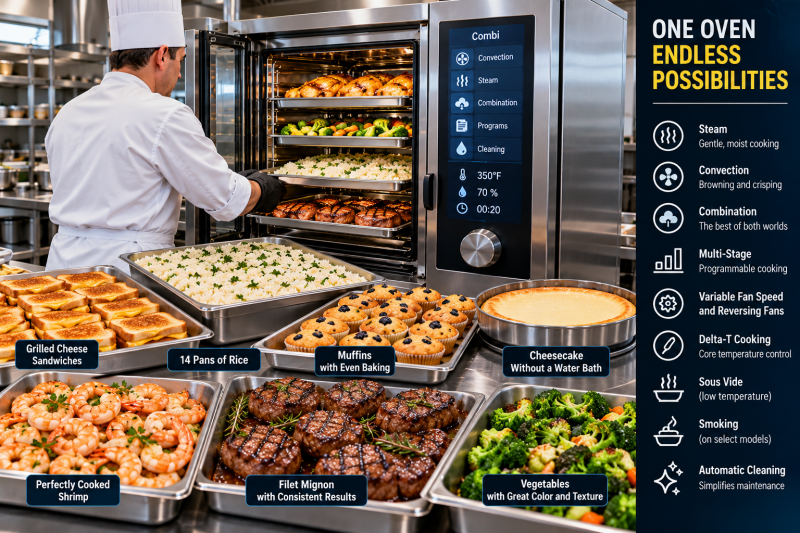
The Combi Oven: Are You Taking Advantage of Everything It Can Do?
One of the most versatile pieces of equipment in a commercial kitchen may also be one of the most misunderstood.
Over my many years in the restaurant and foodservice equipment industry, I've worked with just about every type of commercial cooking equipment imaginable. Few pieces offer the versatility of a combi oven.
Unfortunately, many operators don't fully understand what these ovens are capable of doing. Some purchase an expensive combi oven and use it primarily as a convection oven. Others assume it's simply an oven that adds steam.
They're missing an enormous opportunity.
A combi oven can roast, bake, steam, cook with controlled moisture, and perform multiple cooking stages automatically. Depending on the model, it may also offer sous-vide cooking, smoking, Delta-T cooking, and advanced programmable controls.
But what really impresses me isn't the technology itself. It's what you can accomplish with it.
Three Cooking Methods in One Oven
A combi oven generally offers three primary cooking modes:
Convection: Circulating hot air for roasting, baking, browning, and crisping.
Steam: Moisture-rich cooking for vegetables, seafood, rice, and many other products.
Combination: A combination of heat and moisture management that allows the operator to influence cooking speed, texture, and product quality.
One misconception is that combination cooking always means adding moisture. In reality the moisture becomes an invisible gas that releases energy when making contact. Advanced combi ovens can also remove excess moisture from the cooking cavity to improve browning and crispness. This is often done in separate steps.
I have had people tell me they want to cook 400 degrees at 70% humidity. I believe some manufacturers use this as a selling point but physics says its impossible. The hotter the cavity the less moisture.
Understanding how the equipment works is more important than simply pushing buttons.
Think About Cooking Shrimp
Here's a simple example.
Boiling water is approximately 212°F at sea level. Shrimp cook quickly, and overcooking them by even a short time can produce a rubbery product.
Now imagine cooking shrimp in a combi oven using a moisture-rich environment at approximately 165°F.
The lower cooking temperature provides a gentler process and more control over the finished product. With the correct cooking time and verified safe internal temperature, the result can be beautifully cooked, tender shrimp.
That's the advantage of understanding temperature and moisture rather than automatically using boiling water.
Grilled Cheese Sandwiches in a Combi Oven?
Absolutely!
I've cooked grilled cheese sandwiches in a combi oven.
Imagine assembling an entire sheet pan of grilled cheese sandwiches, loading it into the oven, and producing a large batch in minutes.
Instead of standing over a griddle preparing a few sandwiches at a time, you can produce dozens using a properly developed convection program.
Think about schools, cafeterias, hotels, and high-volume lunch operations.
Sometimes the most impressive applications are the simplest.
Fourteen Hotel Pans of Rice
Here's another example of versatility.
With the appropriate oven capacity, pans, water ratios, and steam program, a combi oven can prepare 14 hotel pans of rice for service.
No multiple stockpots occupying burners. No constant monitoring of boiling water. No transferring large quantities of rice between cooking vessels.
For high-volume operations, that represents a tremendous production advantage.
Of course, cooked rice must be properly held or rapidly chilled because of its particular food-safety risks.
Cooking in Stages
One of my favorite combi oven capabilities is multi-stage programming.
Imagine roasting chicken using three stages.
Stage One: Begin with moisture-rich cooking to promote even heat transfer and protect the product from excessive surface drying.
Stage Two: Transition into combination cooking to continue cooking while developing color and flavor.
Stage Three: Finish with dry convection heat to brown and crisp the skin.
On a properly equipped oven, the entire process can be programmed to change automatically.
No employee needs to stand beside the oven adjusting temperatures and cooking modes throughout the process.
Fan Speed and Direction Matter
Many advanced combi ovens offer variable fan speeds and reversing fans.
Why is that important?
Consider baking muffins.
High-speed airflow during the initial rise can push delicate batter unevenly, causing muffins to rise toward one side.
With a programmable combi oven, you can begin with little or no fan movement, where the equipment allows, and increase airflow during the later baking stages.
Reversing fans can also help promote more even cooking across multiple racks.
This isn't just about controlling heat. It's about controlling airflow.
Cheesecake Without a Water Bath
Traditional cheesecake recipes frequently call for baking in a water bath to create gentle, even heat and reduce cracking.
A combi oven with suitable temperature and moisture controls can create a similar environment without requiring a separate water bath.
With a properly tested program, you can produce beautiful cheesecakes while simplifying preparation.
For bakeries, restaurants, and catering operations, this is another valuable application that often gets overlooked.
Sous Vide, Smoking, and Delta-T Cooking
Depending on the manufacturer and model, combi ovens may offer additional capabilities.
Sous Vide: Certain combi ovens can cook vacuum-sealed foods using precisely controlled low-temperature steam, provided the equipment and process meet food-safety requirements.
Smoking: Some models offer smoking accessories that allow operators to smoke meats, seafood, and vegetables. Proper cleaning and ventilation can minimize residual smoke flavors before the next cooking application.
Delta-T Cooking: On equipped models, the oven adjusts its temperature in relation to the internal temperature of the food. This gentle cooking method can be especially useful for large cuts of meat.
Not every combi oven offers these features, which is why equipment selection matters.
Boilerless Technology and Maintenance
Some combi ovens generate steam directly inside the cooking cavity, while others use a separate boiler.
Both designs have advantages and limitations.
Water quality, filtration, cleaning, descaling, maintenance costs, and production demands should all be considered before purchasing.
Automatic cleaning systems can simplify daily maintenance, but they don't eliminate the need for proper care.
The least expensive oven isn't necessarily the best investment, and the most expensive oven isn't automatically the right choice.
Program It Once, Repeat It Consistently
Perhaps one of the greatest advantages of modern combi ovens is programmable cooking.
Once you've developed the ideal cooking procedure for a menu item, you can save the temperatures, cooking modes, fan speeds, cooking stages, and other settings supported by the equipment.
The next employee follows the same established program.
That means greater consistency, easier training, and less dependence on one individual remembering every step.
The chef establishes the standard. The equipment helps the kitchen repeat it.
Is a Combi Oven Right for Every Operation?
No.
I have cooked prime rib in combi ovens, it does a great job, but I prefer a cook n hold oven for large proteins.
Every piece of equipment has its strengths.
A combi oven can be an outstanding investment, but only when its capabilities match the operation's menu, volume, staffing, and production needs.
My Advice
Before purchasing a combi oven, ask yourself what you intend to cook, how much you need to produce, and which features you'll actually use.
If you already own one, ask whether your employees understand everything it can do.
A combi oven shouldn't be an expensive piece of equipment used for only one or two cooking tasks.
Its greatest value comes from understanding its versatility and putting that versatility to work.
PDM Hospitality Solutions
Practical experience. Better equipment decisions. Smarter foodservice operations.