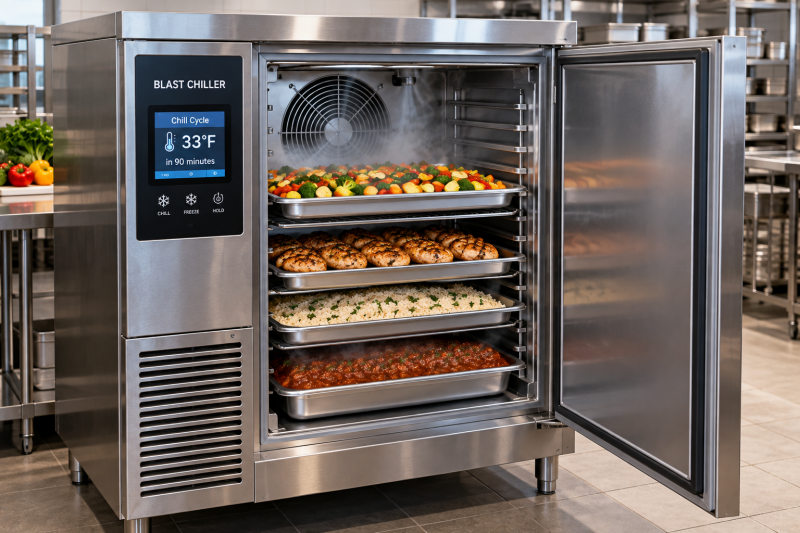
The Most Overlooked Piece of Equipment in a Kitchen
Foodservice operations spend thousands of dollars on ovens, ranges, fryers, griddles and refrigeration. The one piece of equipment that can dramatically improve a kitchen's efficiency is a Blast Chiller.
In many foodservice operations, the blast chiller is primarily viewed as food safety equipment. Rapid cooling food is the main function, the value of this equipment goes well beyond food safety.
When used to its capacity in a kitchen’s production system, a blast chiller can improve labor, reduce waste, expand menus and offer consistent food quality.
Food Safety #1 Priority
Traditional refrigeration is designed to hold cold food at safe temps. It is not designed to rapidly cool any quantity of hot or even warm food.
A Blast Chiller operates like a convection oven. It uses powerful refrigeration and high velocity air circulation to remove heat quickly.
A blast Chiller is a core production tool for operations that cook in advance and retherm for later service..
Food Quality
Blast Chilling limits carryover cooking and will improve quality and consistency of meats, vegetables, sauces and other foods that will be reheated (Rethermed) for service.
Production Efficiency
Instead of scheduling all production immediately before service, operators can prepare selected menu items during slower periods, rapidly chill and refrigerate for later service.
This is particularly valuable for kitchens with limited staff and unpredictable customer demand. Production can be organized around available labor rather than relying on last minute preparation.
A Perfect Partner
Blast chilling becomes especially valuable when paired with a Combi Oven or other equipment designed to reheat previously cooked food.
This approach is very effective in banquet facilities, caterers, hotels,commercial kitchens and restaurants that produce large quantities of prepared food.
Think about your Menu
Are you cooking roasts ? large batches of food ? After the cooking process how is the food handled ?
Do you take a 20 pound roast out of the oven and put it in the refrigerator ? 99% of the time the answer is yes. How long do you think a roast cooked to 130 degrees or turkey breast to 165 to get out of the danger zone. It is well beyond the Health Dept Guidelines.
I cooked 2 pans of lasagna in a 3 inch hotel pan. I put one in a single door refrigerator and one in a blast chiller. It took the Blast Chiller just under 2 hours to get to 38 degrees. The pan in the refrigerator took over 9 hours. Of course when a chef comes in the next day and goes into the refrigerator everything looks great. In the meantime bacteria had time to grow. The refrigerator had to work a little extra to stay at temp. The unnoticed item is that all of the food in the refrigerator was compromised because the hot pan caused the temp in the refrigerator to move to the mid 40 degree range
Bottom Line
Operators invest in equipment that helps them cook faster. More attention needs to be to equipment that allows them to manage production more efficiently. In the right operation a Blast Chiller is an important component in a well designed production system
PDM Hospitality Solutions
Systems Solutions Training