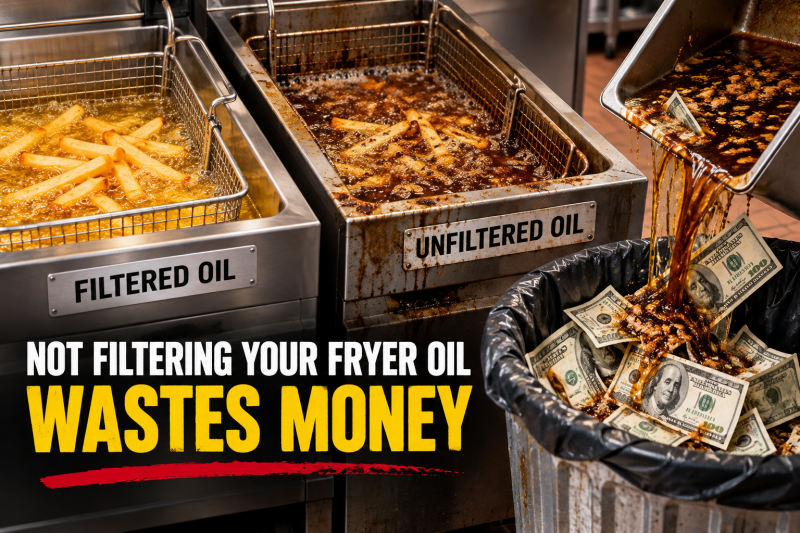
Do You Filter Your Fryer Oil? If Not, Who Are You Kidding?
The difference between good fried food and great fried food may be something your customers never see.
Throughout my years in the foodservice industry, including my time selling food and working with commercial kitchen equipment, I have walked into countless restaurant kitchens.
One thing that always surprised me was how many operators did not regularly filter their fryer oil.
Some didn't filter it at all.
The excuses were usually the same.
"It's too messy."
"We don't have time."
"We change the oil when it gets dirty."
Really?
Who are you kidding?
If you're serving fried food, the condition of your fryer oil has a tremendous effect on the taste, appearance, consistency, and overall quality of what comes out of that kitchen.
And here's something else worth considering.
Proper filtering can actually save you money.
Your Fryer Oil Is Part of Your Recipe
Think about it.
You purchase quality chicken, seafood, potatoes, and other products. You season them properly, bread them carefully, and train your cooks to prepare them correctly.
Then you drop them into poorly maintained fryer oil.
What do you expect?
Every time you fry something, small particles of breading, flour, batter, and food break away and settle into the oil.
Those particles continue cooking. Eventually, they burn.
Now you're cooking your next order of food in oil contaminated with burnt food particles.
That affects flavor.
It affects color.
It affects quality.
And your customers notice, even if they don't know why.
A perfectly good piece of fish can come out darker than it should, with an unpleasant aftertaste, simply because the oil hasn't been properly maintained.
Filtering Oil Isn't the Same as Changing Oil
This is something every kitchen manager should understand.
Filtering removes crumbs, sediment, and other suspended food particles that contribute to oil deterioration.
It helps maintain cleaner oil and can extend its useful life.
But filtering does not restore oil that has already chemically broken down.
Heat, oxygen, moisture, and repeated cooking eventually degrade frying oil. Once the oil is worn out, filtering won't make it new again.
You still need to replace it.
The objective is to get the maximum useful life out of your oil without sacrificing food quality.
That is good kitchen management.
Yes, Filtering Can Be a Messy Job
I've worked in enough kitchens to know that filtering fryer oil isn't anyone's favorite assignment.
It can be messy.
It takes time.
And if employees aren't properly trained, it can be dangerous.
But that's no excuse for ignoring it.
Today's commercial kitchens have access to built-in filtration systems, portable filtering equipment, and other tools that make the process easier.
Even with older equipment, a properly developed procedure can make filtering part of the normal kitchen routine.
Train your employees, provide the proper equipment, and follow the fryer's recommended safe filtering procedures.
Never improvise with hot oil.
Filtering should be a scheduled responsibility, not something employees do only when they have extra time.
Dirty Oil Is Expensive Oil
Let's talk about money.
Restaurant operators spend considerable time negotiating food prices, controlling portions, and monitoring waste.
Yet some pay little attention to how much money they're wasting on fryer oil.
Consider a simple example.
Suppose your fryers hold a combined 100 pounds of oil.
At $1.25 per pound, that's $125 every time you completely replace the oil.
If poor maintenance causes you to replace it every four days instead of every six days, here's what happens over a 30-day period.
- Every four days: approximately $938 in oil.
- Every six days: approximately $625 in oil.
- Potential difference: approximately $313 per month.
That's roughly $3,750 annually.
And that's just one operation.
These numbers are illustrative, not a promise that filtering will extend every oil's life by 50%. Actual savings depend on your menu, frying volume, oil type, operating temperature, and maintenance practices.
But the point remains.
Why spend money unnecessarily when a simple operating procedure may help you control that expense?
Your Menu Determines How You Manage Your Oil
Not all fried foods affect oil the same way.
Fresh-cut French fries, lightly battered seafood, heavily breaded chicken, and frozen appetizers all place different demands on a fryer.
Breaded products can leave considerable sediment behind.
Certain foods transfer flavors and odors to the oil.
Cooking temperature, production volume, and the amount of moisture entering the fryer also affect oil life.
A busy seafood restaurant may need to filter more frequently than an operation primarily cooking French fries.
There isn't one perfect filtering schedule for every kitchen.
That's why management needs to establish procedures based on what the kitchen actually produces.
What About Your Employees?
Here's something I've always believed.
If you expect employees to perform a task, you need to give them the training, tools, and time to do it correctly.
Don't tell your closing cook to filter three fryers and then complain that closing takes too long.
Build the task into the schedule.
Explain why it matters.
Make sure employees understand the effect on food quality and operating costs.
And most importantly, make it part of your daily kitchen standards.
A procedure that nobody follows isn't much of a procedure.
A Few Simple Rules
Every restaurant operating a deep fryer should have a written oil management program.
It should address:
- Filtering frequency based on production and equipment recommendations.
- Regular removal of crumbs and sediment.
- Proper frying temperatures and recovery times.
- Safe filtering procedures and protective equipment.
- When oil must be discarded because of deterioration.
- Cleaning fryers according to manufacturer instructions.
- Assigning responsibility and verifying that the work is completed.
Oil should be evaluated for signs of deterioration, including excessive foaming, smoking at normal operating temperatures, persistent off-odors, and poor food quality. Oil-testing equipment can also help establish more objective replacement decisions.
Dark color alone isn't always a reliable indicator of oil condition.
The Customer Doesn't Know Why. They Just Know.
Here's what concerns me most.
A customer orders fried shrimp at your restaurant.
The shrimp are fresh.
The breading is excellent.
The cook prepares them correctly.
But the oil hasn't been properly maintained.
The shrimp arrive at the table darker than expected, perhaps with an unpleasant flavor.
The customer doesn't know about your fryer oil.
They don't know about your filtering schedule.
And they certainly don't care about your closing procedures.
They just know the shrimp weren't very good.
Maybe they won't order them again.
Maybe they won't come back.
Now tell me, what did that cost?
My Final Thought
In all my years in foodservice, I've learned that the little things often make the biggest difference.
Filtering fryer oil isn't glamorous.
It won't bring customers through the front door.
Nobody is going to compliment your manager because the fryer was filtered last night.
But they will notice consistently good French fries, golden fried chicken, and seafood that tastes the way it should.
Proper oil maintenance protects your food quality, helps control costs, and supports consistency.
If you're not filtering your fryer oil, you're probably paying for it twice: once in unnecessary oil expense and again in the quality of the food you serve.
And that's money no restaurant can afford to waste.
PDM Hospitality Solutions
Systems • Solutions • Training
Practical foodservice solutions from someone who has spent a career working in kitchens, managing operations, and helping foodservice professionals improve their businesses.
No contracts. No unnecessary overhead. Just practical results.
PDMhospitalitysolutions.com