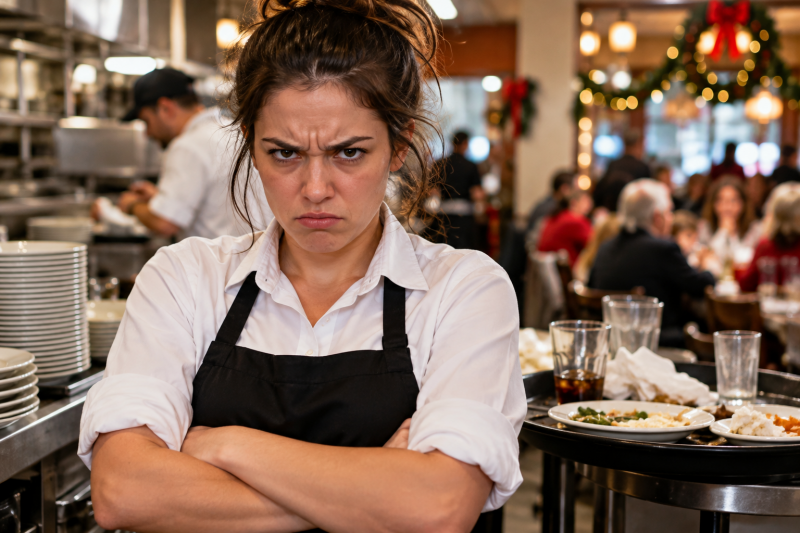
Is Opening on Thanksgiving or Christmas Really Worth It?
The hidden costs of holiday dining that restaurant owners should consider.
By PDM Hospitality Solutions
Every year, restaurants face the same question: Should we open on Thanksgiving and Christmas?
For many owners, the answer seems obvious. Families are celebrating, people are dining out, and there's an opportunity to generate additional revenue.
But after spending years managing restaurants and working in foodservice operations, I have a different perspective.
Just because you can generate sales doesn't mean you're making money.
And sometimes the cost of opening goes well beyond dollars and cents.
What About Your Employees?
Let's start with something I believe doesn't get enough consideration: your employees.
Thanksgiving and Christmas are family holidays. People want to spend time with their spouses, children, parents, and friends.
Yet restaurants sometimes expect their employees to give up those holidays because management sees an opportunity to increase sales.
I've always believed that taking care of your employees is part of running a successful operation.
Employee retention isn't just about wages. It's about respect, consideration, and creating a workplace where people want to stay.
An employee who resents being forced to work Christmas may eventually leave. Replacing a good employee can cost far more than whatever additional profit the restaurant generated that day.
Large Parties Don't Always Mean Large Profits
Holiday dining brings its own set of challenges.
Large family parties often occupy tables much longer than normal. Children may be running around, guests arrive at different times, and service becomes more complicated.
A table that would normally turn in an hour or so may be occupied for two or three hours.
Meanwhile, other customers are waiting.
Add unpredictable weather, last-minute cancellations, and no-shows, and suddenly the sales projections that looked so promising aren't quite as attractive.
A full dining room doesn't necessarily mean a profitable dining room.
I Have Never Been a Fan of Special Holiday Menus
Here's another issue that has always bothered me.
On a few occasions over the years, I've gone to a restaurant expecting to order something from its regular menu, only to discover that the restaurant was offering a special holiday menu instead.
The regular menu wasn't available.
I didn't go to that restaurant because I wanted a special holiday meal. I went because I enjoyed what the restaurant normally served.
Restaurants spend years building a reputation around their food. Customers develop favorite dishes and return because they know what to expect.
Then, on a major holiday, management decides to eliminate those choices and substitute a limited menu, sometimes at higher prices.
Why?
A special holiday menu may work for a restaurant whose guests specifically want that experience. But taking away the regular menu can also disappoint loyal customers.
If you're going to change the menu, make sure customers know before they make reservations.
Your Kitchen Was Designed Around Your Menu, Not Thanksgiving
This is where my background in commercial kitchen equipment and restaurant operations comes into play.
A restaurant's kitchen is generally designed around its normal menu, anticipated volume, and production requirements.
The refrigeration, ovens, cooking equipment, preparation areas, and storage capacity are selected to support that operation.
Now imagine deciding to serve a traditional Thanksgiving dinner.
You expect a big crowd, so you plan to prepare 20 turkeys.
Where are you going to cook 20 turkeys?
Where are you going to refrigerate them before cooking? If they're prepared in advance, do you have the capacity to cool them safely? Where will you hold them at safe temperatures during service?
And that's just the turkey.
You still have stuffing, mashed potatoes, vegetables, gravy, cranberry sauce, rolls, and desserts.
Your walk-in refrigerator is already supporting your normal restaurant operation.
Your ovens weren't necessarily purchased to cook 20 turkeys.
Your kitchen staff may not be accustomed to producing hundreds of portions of a banquet-style meal.
The menu changed, but the kitchen didn't.
Can it be done? Of course. With proper planning, equipment, and production systems, restaurants can execute large holiday meals successfully.
But just because you have an oven doesn't mean you have the capacity to operate a holiday banquet kitchen.
What Happens to All That Food the Next Day?
Here's something else owners need to consider.
Thanksgiving is over. The restaurant closes, and now you're looking at leftover turkey, stuffing, mashed potatoes, vegetables, gravy, and desserts.
What are you going to do with it?
Some food may be safely cooled, stored, and repurposed. Other items may have limited shelf life or may not fit your regular menu.
You can't simply assume that everything left over can be sold the following day.
And how many customers are coming in on Friday looking for another turkey dinner?
Probably not as many as you would like.
Now you're dealing with additional food cost, refrigeration space, labor to handle the leftovers, and potentially significant waste.
If you're evaluating the profitability of Thanksgiving, you need to include the cost of food that was purchased and prepared but never sold.
The holiday's sales report may look impressive. The actual profit may tell a different story.
Are You Really Making Money?
Let's consider everything that goes into opening on a major holiday.
You have food and beverage costs, labor, utilities, credit card fees, additional preparation, potential holiday wage premiums, and possible food waste.
You may also have reduced table turnover, longer service times, and the expense of managing an unusually demanding operation.
The right question isn't how much money the restaurant took in.
The right question is:
How much additional profit did we actually make by opening?
That means looking at the revenue minus the costs directly associated with opening, including waste and any additional expenses.
If the restaurant normally closes on that holiday, compare the actual additional profit against the operational demands and the effect on your employees.
You might discover that a day everyone thought was extremely successful wasn't nearly as profitable as expected.
Should Employees Be Paid When the Restaurant Closes?
I believe employees should have a choice whenever possible.
If a restaurant normally operates on a day that happens to be Christmas or Thanksgiving, I would favor giving employees the option of taking the day off without pay or working another available shift to make up the hours.
In my own working life, if someone told me I could have Christmas off without pay, I'd gladly take it.
I wouldn't expect the restaurant to pay me for a day I didn't work.
But I would appreciate having the choice.
Of course, any policy needs to comply with applicable wage laws, employment agreements, and company policies. Employees who qualify for paid holidays should receive those benefits.
The point is that respecting employees doesn't always require spending more money.
Sometimes it simply requires giving people flexibility and treating them like individuals.
And if a restaurant does decide to open, I would favor asking for volunteers first and considering additional compensation for employees willing to work.
Maybe There's a Better Way
Rather than opening on Thanksgiving or Christmas, why not build business around the holiday?
Promote preordered family dinners in the days leading up to Thanksgiving. Offer properly planned holiday meals to go. Encourage office parties, family gatherings, and celebrations throughout December.
There are opportunities to generate revenue without necessarily opening on the holiday itself.
And imagine posting this message:
"We will be closed on Christmas Day so our employees can enjoy the holiday with their families. We appreciate their hard work throughout the year and wish everyone a wonderful Christmas."
That's not necessarily lost business.
That's an investment in your employees, your reputation, and the kind of restaurant you want to operate.
Final Thoughts
I'm not suggesting that every restaurant should close on Thanksgiving and Christmas.
Hotels, resorts, casinos, and restaurants that specialize in holiday dining may have the equipment, staffing, customer demand, and operating systems to make these days successful.
But for the average independent restaurant, I would think long and hard before opening.
Consider the employees who would rather be home. Consider the families who may be disappointed by a limited menu. Consider the kitchen that wasn't designed for holiday banquet production. Consider the leftover food, the additional labor, and the possibility that a busy day may not be a particularly profitable one.
If your restaurant does a million dollars per year, and you close Thanksgiving and Christmas. Guess what at the end of the year you will still have made a million dollars. As a manager who has been victim to these holidays, it's not worth it and terrible for employee morale.
Most importantly, don't confuse revenue with profit.
Sometimes the smartest business decision isn't figuring out how to make another dollar. It's recognizing when making that dollar isn't worth the cost.
PDM Hospitality Solutions
Systems • Solutions • Training
Practical foodservice consulting built on real operational experience.
PDMhospitalitysolutions.com