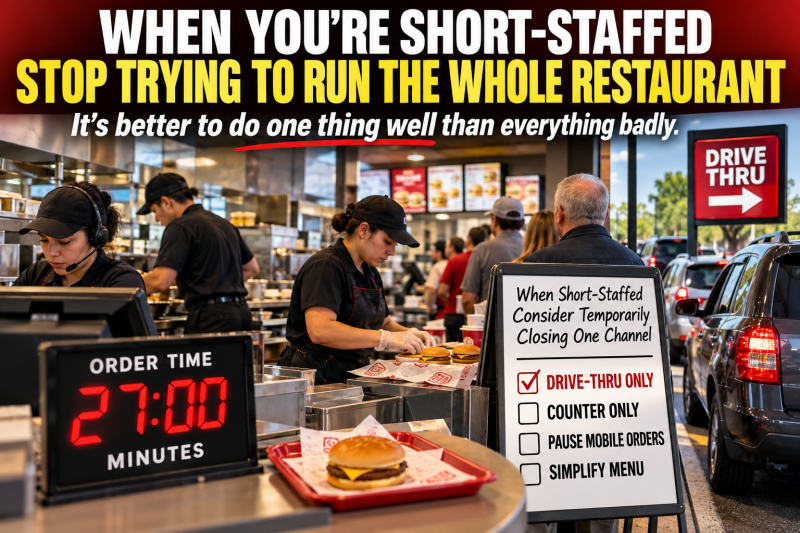
When You're Short-Staffed, Stop Trying to Run the Whole Restaurant
It's Better to Do One Thing Well Than Everything Badly
By PDM Hospitality Solutions — Systems • Solutions • Training
A 27-Minute Wait for a Cheeseburger
Recently, I stopped at a Wendy's for a quick bite to eat. I ordered a simple kids cheeseburger. Nothing complicated.
Twenty-seven minutes later, I finally received my burger.
As someone who has spent over 50 years in the foodservice industry, I couldn't help but observe what was happening.
Several employees had apparently called in sick, leaving only three people working. Meanwhile, the restaurant continued taking orders at the front counter and serving customers through the drive-thru.
The employees were doing their best, but they were clearly overwhelmed.
I experienced a similar situation at a Dunkin' Donuts.
Both experiences made me ask a simple question:
Why are we trying to operate everything when we don't have enough people to operate anything properly?
Sometimes Less Is More
When a restaurant is severely short-staffed, management has a decision to make.
Do we continue operating every service channel, knowing we're going to disappoint customers? Or do we temporarily reduce operations and concentrate on delivering a better experience?
My answer is simple.
It's better to do one thing well than everything badly.
If you only have enough employees to properly operate the drive-thru, consider temporarily closing the front counter to new orders.
If your counter business is more manageable, perhaps that's where you should concentrate.
And don't forget mobile and third-party delivery orders. Those orders place additional demands on an already overwhelmed kitchen.
The right decision depends on staffing, equipment, customer demand, and company policies. But doing nothing shouldn't be the default.
You're Not Just Losing Time. You're Losing Customers.
Think about the customer who walks into a fast-food restaurant expecting a meal in five or ten minutes.
Twenty-seven minutes later, that customer is frustrated, disappointed, and probably questioning whether to return.
You may have collected the money for that cheeseburger, but what did you lose in the process?
You may have lost a repeat customer.
Worse yet, an unhappy customer may tell friends, family, or post a negative review online.
That one cheeseburger could end up costing considerably more than the revenue it generated.
Communication Is Part of Hospitality
Here's another problem I observed.
Nobody warned me about the wait.
Had someone said, "We're extremely short-staffed today, and orders are taking approximately 25 minutes," I could have made an informed decision.
I might have stayed. I might have gone somewhere else.
But at least I would have known what to expect.
Customers are generally more understanding of a problem when you communicate honestly before it becomes their problem.
Hospitality isn't just about smiling and saying thank you. It's also about respecting the customer's time.
Protect Your Employees, Too
There's another side to this situation that managers sometimes overlook.
Imagine being one of those three employees.
You're cooking, assembling orders, answering questions, dealing with frustrated customers, and watching the order screen fill faster than you can clear it.
The pressure builds. Mistakes happen. Tempers get short.
And the employees who actually showed up for work end up paying the price for being short-staffed.
That's not good management.
A smart manager recognizes when the operation has exceeded the team's capacity and makes adjustments.
Sometimes the best thing you can do for your employees is reduce the workload to something they can realistically handle.
Have a Short-Staffing Plan Before It Happens
Every restaurant should have a contingency plan for unexpected staffing shortages.
That plan should answer five basic questions:
- What is the minimum staffing required to operate each service channel effectively?
- Which channel should receive priority based on customer demand and profitability?
- When should we temporarily suspend counter, drive-thru, mobile, or delivery orders?
- Can we simplify the menu or temporarily eliminate labor-intensive items?
- How will we communicate delays and service changes to customers?
These decisions should be made before the restaurant is overwhelmed, not after customers have been waiting 30 minutes.
Managers should also understand that temporarily reducing service is not necessarily admitting defeat.
Sometimes it's the smartest operational decision available.
Sales Don't Mean Much If the Experience Is Terrible
I understand the pressure restaurant managers face.
Corporate wants sales. Owners want revenue. Managers are measured on performance.
But there's a difference between generating sales and building a successful business.
Taking more orders than your staff can properly handle isn't necessarily increasing profitability.
Long ticket times, incorrect orders, refunds, food waste, stressed employees, and dissatisfied customers all have costs.
Sometimes reducing the number of orders you accept can actually protect the business.
My Final Thought
I've spent a lifetime in restaurants, from the kitchen to management and beyond.
One lesson I've learned is that good management isn't always about doing more.
Sometimes it's about knowing when to do less.
If you're short-staffed, adjust your operation. Protect your employees. Communicate with your guests. And concentrate on delivering the best possible experience with the resources you have.
I'd rather serve 50 customers exceptionally well than serve 100 customers poorly.
Because the 50 satisfied customers are much more likely to come back.
And isn't that what the restaurant business is all about?
PDM Hospitality Solutions
Systems • Solutions • Training
Practical restaurant solutions built on over 50 years of real-world foodservice experience.
No Contracts • No BS • Honest, Straightforward Advice
Let's Get to Work.
Short staffed