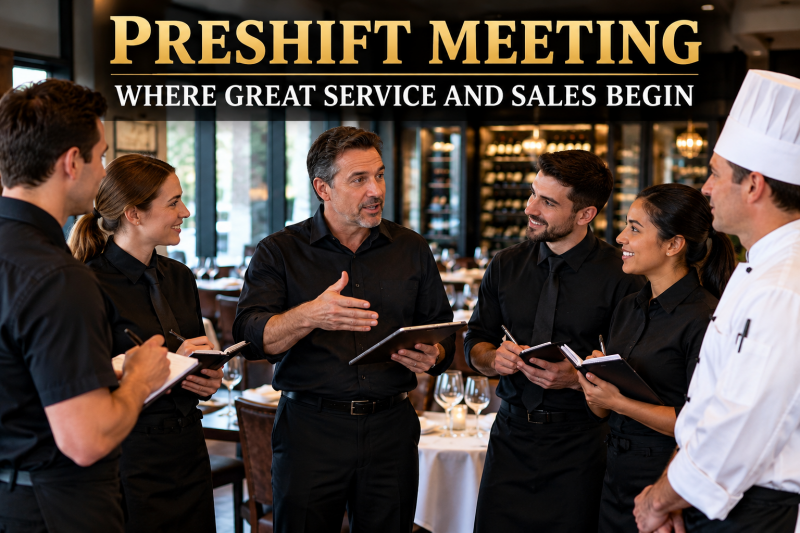
The Pre-shift Meeting: Where Great Service and Sales Begin
I've always believed that one of the most important responsibilities of a restaurant manager is conducting an effective preshift meeting.
A good preshift meeting doesn't have to take 30 minutes. Sometimes five or ten minutes is all it takes. But those few minutes can make a tremendous difference in service, sales, and employee confidence.
It's management's responsibility to make sure every server knows what they're selling before the first guest walks through the door.
That means reviewing the day's specials, featured appetizers, cocktails, wine recommendations, desserts, and anything else the restaurant wants to promote.
But simply announcing the specials isn't enough.
Servers need to understand the products and feel comfortable recommending them.
You Can't Sell Something You Don't Believe In
Let's say tonight's special is grilled salmon.
What happens if a server doesn't like salmon? Maybe they don't even eat fish.
How enthusiastic do you think that server will be when recommending it?
I don't believe in forcing servers to pretend they love something they don't.
Instead, give them options.
If a server doesn't enjoy seafood, let them choose a favorite steak, chicken dish, pasta, or appetizer they genuinely enjoy.
Teach them the important talking points about that item and let them make the recommendation in their own words.
They still need to know the salmon special well enough to describe it accurately and answer questions. But they don't have to pretend it's their personal favorite.
Genuine enthusiasm is much more convincing than a memorized sales pitch.
Put the Product in Front of the Servers
Here's something I believe restaurants should do more often.
During the preshift meeting, bring out an actual dessert.
Don't just tell the staff about the chocolate cake. Put a slice on the table.
Let them see the presentation, smell the chocolate, and taste it when practical.
Explain the ingredients, portion size, and what makes it special.
Imagine bringing out a beautiful warm chocolate cake with vanilla ice cream and chocolate sauce.
Now your servers have actually experienced the dessert.
When they approach a table later that evening, their description becomes much more natural.
"Our warm chocolate cake is fantastic. We tried it before service, and it's especially good with the vanilla ice cream."
That's a genuine recommendation.
I would do the same with featured appetizers, entrées, and specialty beverages when practical.
A dessert presented at preshift can become one of the most effective sales tools in the restaurant.
Some Servers Take the Job for the Money, Not the Passion
Let's learn something about the restaurant business.
Not every person who applies for a serving position has a passion for hospitality.
Many are attracted by the opportunity to make good money, enjoy flexible hours, or work their way through school.
And there's nothing wrong with that.
But some may initially lack enthusiasm, product knowledge, or confidence.
That's where good management and training come in.
Instead of simply telling employees to sell more, show them how better service and recommendations can increase their earnings.
Suppose a server handles 20 guests during a shift and learns to generate an additional $5 in sales per guest.
That's $100 in additional sales.
At an illustrative 20% tip rate, that could mean an additional $20 in tips for that shift, before tip-outs or pooling, assuming guests tip proportionally.
Over five shifts, that's potentially $100 more.
Of course, tips aren't guaranteed, and check size is only one factor. But employees can see how improving their skills creates an opportunity to earn more.
The manager has turned training into something the employee personally values.
Success Is Contagious
This is one of my favorite parts of restaurant management.
Imagine you have two servers working the same shift.
One has learned how to recommend appetizers, suggest wine pairings, describe desserts, and offer after-dinner drinks.
The other simply takes orders.
Over time, the first server may begin generating higher average checks and earning better tips.
Eventually, the other server notices.
What's different? Why is that server making more money?
Now you have an opportunity to coach.
Instead of management constantly pushing employees to sell, employees begin learning from each other.
They share successful talking points. They discuss what recommendations work. They become more confident.
Success is contagious, and so is enthusiasm.
When servers see that better product knowledge and genuine recommendations can improve their earnings, training stops feeling like another management requirement.
It becomes an opportunity.
The Manager Sets the Tone
A manager who walks into a preshift meeting unprepared shouldn't expect the staff to be prepared either.
Management needs to lead by example.
Bring enthusiasm to the meeting. Know the specials. Present the products. Encourage questions. Recognize servers who are improving.
Most importantly, make the training positive.
Don't embarrass someone who doesn't know an answer. Teach them.
Don't demand that every server sound alike. Help each one develop a comfortable selling style.
And don't measure success only by sales. Guest satisfaction, teamwork, accuracy, and repeat business are equally important.
My Bottom Line
I don't believe great servers are necessarily born with exceptional sales skills.
Many develop those skills because someone took the time to train them properly.
A five-minute preshift meeting can give servers the confidence to make better recommendations, increase restaurant revenue, and improve their own earning potential.
Give servers the knowledge. Let them develop their own style. Show them the financial rewards of better service.
And remember:
Success is contagious. When one server starts succeeding, others will want to know how.
PDM Hospitality Solutions — Systems • Solutions • Training