Great Food, Great Service, Empty Tables — Could Your Storefront Be the Problem?
Your restaurant's first impression begins long before the customer walks through the door.
By PDM Hospitality Solutions
Recently, I visited a Mexican restaurant that left me wondering why it wasn't doing more business.
The food was outstanding. In fact, some of the best Mexican food I've ever eaten. The service was excellent, the restaurant was beautifully decorated, and the overall dining experience was everything a customer could ask for.
Yet something was missing.
Customers.
I've visited this restaurant several times, and I don't believe I've ever seen more than three parties dining there at once.
Now, I certainly don't know their financial situation, their takeout volume, or how busy they might be at other times. But from my observations, this restaurant deserves considerably more attention than it appears to be getting.
And I have a theory about one possible reason.
The problem may begin outside the restaurant.
A Restaurant That Looks Closed Even When It's Open
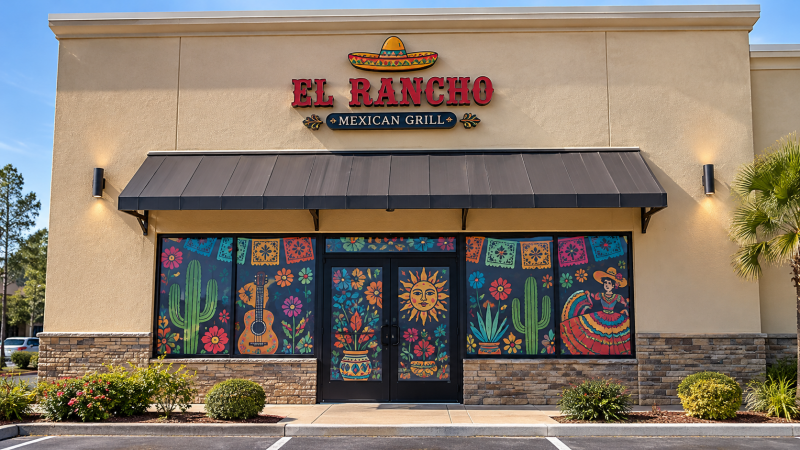
The restaurant has a colorful Mexican-themed exterior, but nearly every front window is covered with decorative decals.
From the parking lot, you cannot see the beautiful dining room. You cannot see customers enjoying their meals. You cannot see the warm atmosphere or the excellent interior decor.
In fact, it's difficult to tell whether the restaurant is even open.
Once inside, the situation is similar. The windows are so heavily covered that customers can barely see outside.
Think about that for a moment.
Here is a restaurant that has invested in creating a wonderful dining experience, yet it has effectively hidden that experience from potential customers.
The restaurant may be doing almost everything right inside while sending the wrong message outside.
Your Storefront Is Part of Your Marketing Program
Restaurant owners spend considerable money on advertising, websites, social media, and promotions to attract customers.
But what about the building itself?
Your storefront is advertising your restaurant every hour of every day.
Customers driving through a shopping center or walking past a restaurant are constantly making quick judgments.
Does this place look inviting?
Is it clean and attractive?
Can I see inside?
Does it look busy?
Is it even open?
A restaurant doesn't have to answer every one of these questions through its windows. Some successful concepts deliberately create a private, enclosed atmosphere.
But for a casual neighborhood restaurant that depends on attracting new customers, visibility can be a tremendous advantage.
Why spend money attracting customers to a building that doesn't look inviting when they arrive?
People Attract People
One of the most overlooked marketing advantages a restaurant has is the ability to show potential customers that other people are enjoying themselves.
Think about walking down a street with several restaurants.
One has dark windows, little visible activity, and an entrance that makes you wonder whether it's open.
Another has warm lighting, attractive tables, and customers enjoying food and conversation.
Which one is more likely to catch your attention?
There's a reason busy restaurants often attract even more customers. Seeing people enjoying themselves can create confidence and curiosity.
Of course, an empty dining room visible from outside isn't necessarily helpful either. Window visibility needs to be considered alongside lighting, layout, and the overall presentation.
But completely covering the windows eliminates the opportunity to showcase the restaurant's atmosphere.
The Importance of Natural Light
Windows do more than allow customers to see inside.
They can also improve the dining experience for customers already seated.
Natural light can make a dining room feel more open and welcoming. A view of the outside creates a connection with the surrounding environment.
Not every restaurant needs large uncovered windows. Fine dining establishments, romantic restaurants, and themed concepts sometimes benefit from a darker, more intimate atmosphere.
The important question is whether the design supports the concept.
In this particular Mexican restaurant, I found the interior attractive and comfortable. But I couldn't help wondering whether opening up some of those windows would make an already pleasant dining room even better.
Five Changes I Would Consider Before Spending Money on Advertising
If I were consulting with this restaurant, I wouldn't immediately recommend an expensive renovation or a major marketing campaign.
I would begin with several practical, relatively inexpensive improvements.
- Remove some of the window coverings.
Not necessarily all of them. Mexican-themed decorations can add character and personality. But allowing people to see portions of the dining room could make the restaurant feel more welcoming.
- Make it obvious the restaurant is open.
An attractive illuminated OPEN sign, better entrance lighting, and clearly displayed hours could eliminate confusion.
A potential customer should never have to guess whether a restaurant is operating.
- Display the menu outside.
I've always liked the idea of placing a menu where potential customers can review it before entering.
Let them see the variety, specialties, and prices. Give them a reason to walk inside.
- Improve the exterior lighting and presentation.
The entrance should draw attention to the restaurant. Attractive lighting, clean signage, and a clearly defined entrance can make a significant difference in how a business is perceived.
- Test the changes and measure the results.
Before making major investments, try removing decals from a few windows and improving the entrance.
Track customer counts, walk-in traffic, and sales over several weeks. Compare similar days and account for weather, holidays, and seasonal changes.
Ask new customers how they discovered the restaurant.
The goal isn't simply to make the building look better. It's to determine whether the improvements help bring in more business.
Don't Assume the Problem Is Always in the Kitchen
Over my years in foodservice, I've learned that restaurant problems aren't always where people expect to find them.
When sales are disappointing, owners may immediately question their menu, pricing, food quality, employees, or advertising.
Those are all legitimate areas to examine.
But sometimes the issue is something much simpler.
A poorly placed sign.
An unattractive entrance.
A menu that customers can't easily understand.
A building that looks closed.
Or windows that prevent potential customers from seeing a beautiful restaurant inside.
None of these factors alone proves why a restaurant is struggling. Location, competition, marketing, reputation, operating hours, and many other factors must also be considered.
But overlooking the obvious can be expensive.
The Customer Experience Begins Before the Front Door
I genuinely enjoy this Mexican restaurant, and I hope it succeeds. The food and service deserve recognition.
My observations are not a criticism of the people operating it. They're an example of how even a very good restaurant may have opportunities for improvement that aren't immediately apparent to its owners.
Sometimes, when we see the same building every day, we stop noticing what a first-time customer sees.
That's why looking at a restaurant through the customer's eyes is so important.
Stand across the parking lot and look at your business.
Forget that you're the owner.
Forget that you know how good the food is.
Forget that you know how beautiful the dining room looks.
Now ask yourself one simple question:
"If I had never been here before, would this restaurant make me want to walk through the door?"
Because you can have the best food in town, outstanding employees, and a beautiful dining room.
But none of those things matter to a potential customer who never comes inside.
PDM Hospitality Solutions
Practical Restaurant Consulting. Real-World Experience. No Big-Firm Overhead.
Helping restaurant owners improve operations, increase sales, develop employees, and create better guest experiences.