Do You Know What Supplies You Have on Hand?
Why Inventory Control, Par Levels, and Planning Matter More Than You Think
PDM Hospitality Solutions | Systems • Solutions • Training
Over my years in the foodservice industry, I've seen restaurant operators pay close attention to food cost, labor cost, and beverage cost. But there's another expense that often gets overlooked until something goes wrong.
Operating supplies.
I'm talking about glassware, china, silverware, kitchen utensils, serving pieces, cleaning supplies, and all those other items necessary to operate a restaurant.
Let me ask a simple question.
Do you know what you have on hand, or do you wait until someone tells you you're running out?
There's a big difference between managing your supplies and simply ordering them.
Stop Ordering in an Emergency
How many times has this happened?
It's Friday afternoon. You have a busy weekend ahead, and suddenly someone tells you you're running low on wine glasses.
Or perhaps you have a large party coming in Saturday night, and nobody thought to check whether you have enough dinner plates, coffee cups, or silverware.
Now you're scrambling.
Someone has to call a supplier, arrange an emergency delivery, or drive somewhere to purchase what you need.
And there's a good chance you'll pay more than you normally would.
Poor planning has a price.
The frustrating part is that most of these situations are completely avoidable.
Establish Par Levels — Know When to Order
One thing I always liked doing as a restaurant manager was establishing par levels for operating supplies.
I loved it when another manager from another store would call and say I need a case of what ever really fast I'm screwed. I'd say sure we have it.
It's a simple concept that can prevent a lot of problems.
Let's say your restaurant normally maintains five cases of a particular glass in inventory.
You establish a minimum of two cases.
When your reserve inventory drops to two cases, it's time to reorder enough to bring your stock back to five cases.
Don't wait until you're down to your last case or until someone tells you you're completely out.
A good par system takes the guesswork out of purchasing.
But your par levels shouldn't be arbitrary numbers.
They should reflect your business volume, delivery schedules, special events, and how quickly supplies can be replaced.
A busy restaurant may need more backup glassware than a small neighborhood operation.
And a restaurant that can receive supplies the next morning has different requirements from one that must wait two weeks for a delivery.
The important thing is to establish a system and follow it.
What Happens When the Unexpected Occurs?
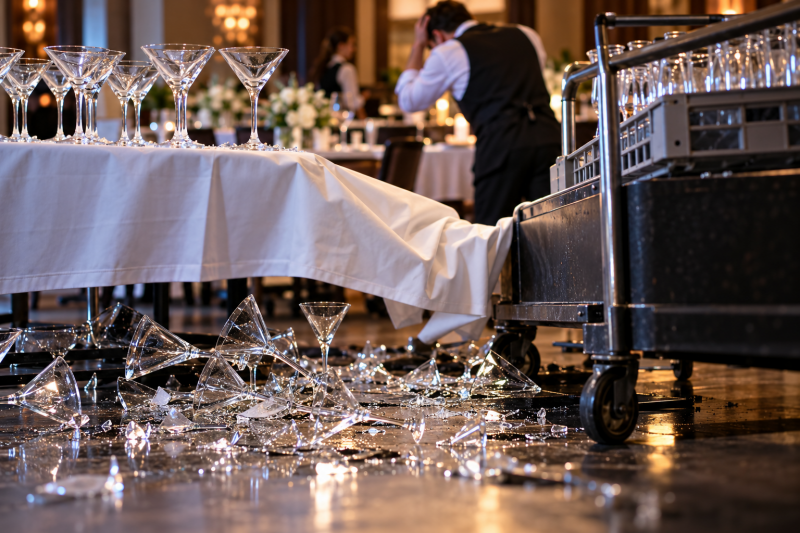
Suppose an employee is unloading the dishwasher and accidentally drops an entire rack of wine glasses.
Suddenly, your inventory has been dramatically reduced.
Do you have enough backup inventory to continue serving your customers properly?
Or are you going to start serving wine in whatever glasses happen to be available?
This reminds me of something that happened to me years ago.
The Martini Glass Disaster
I was working a function where we needed a large number of martini glasses.
During setup, I had arranged the glasses on a table so everything would be ready when the guests arrived.
Unfortunately, a busman accidentally crashed a large cart into the table.
Most of the martini glasses were broken.
Now we had a problem.
Guests began ordering martinis, and we didn't have enough proper glasses to serve them.
Imagine ordering a straight-up martini and having it served in a rocks glass.
That's exactly what happened.
And believe me, the customers weren't happy.
The drinks themselves may have been perfectly prepared, but the presentation was wrong.
That experience reinforced something I've believed throughout my career.
Having enough supplies for normal business isn't always enough. You need to be prepared when something goes wrong.
A customer doesn't care that someone accidentally broke your glassware.
They expect the drink they ordered to be served properly.
And they should.
Anticipate Your Needs Before They Become Problems
One thing I always believed in as a restaurant manager was knowing what I had on hand.
Not guessing. Knowing.
If I had a large party scheduled, a holiday approaching, or a special promotion planned, I wanted to know whether we had the supplies necessary to handle the business.
Think about a restaurant that normally serves 150 dinners but has a special event expected to bring in another 100 guests.
Do you have enough glassware?
What about dinner plates, appetizer plates, and silverware?
Can your dishwasher keep up with the additional volume?
Having 200 dinner plates doesn't necessarily mean you can comfortably serve 200 people.
Some plates will be in use, some will be waiting to be washed, and others may be needed for additional courses.
Your supply levels should reflect your actual operation, not just the number of seats in your dining room.
And don't forget special events.
If you're planning a wine dinner, a cocktail promotion, or a holiday buffet, review the supplies you'll need well before the event.
Don't discover a shortage when the guests start arriving.
Establish a Simple Supply Inventory System
You don't need an elaborate computer program to control operating supplies.
A simple inventory sheet can tell you a great deal.
Start by identifying your major supply categories:
- Glassware: Wine glasses, beer glasses, cocktail glasses, water glasses, martini glasses
- China: Dinner plates, appetizer plates, bowls, coffee cups, saucers
- Flatware: Forks, knives, teaspoons, soup spoons
- Kitchen supplies: Utensils, storage containers, smallwares
- Cleaning and disposable supplies: Chemicals, paper products, gloves, takeout containers
For each item, establish how much you normally want on hand, your reorder point, and how much you need to purchase.
For example:
Item
Target Par
Reorder Point
Water glasses
5 cases
2 cases
Wine glasses
4 cases
2 cases
Martini glasses
3 cases
1 case
Dinner plates
300
225
Dinner forks
300
225
These are examples only. Every operation should establish par levels based on its own volume and needs.
High-loss items may need weekly checks, while others can be counted monthly.
And make sure someone is responsible for reviewing the numbers.
A system that nobody follows isn't much of a system.
Budget Your Supply Purchases
Here's something I believe many operators overlook.
You can have a very profitable month and give back a significant portion of that profit with one large supply order.
Let's say your restaurant has an excellent month.
Sales are strong, labor is controlled, and food cost is right where it should be.
Then someone decides it's time to replace glassware, purchase new china, and stock up on kitchen supplies.
Suddenly you're looking at a $4,000 or $5,000 invoice.
Some of those purchases may have been necessary.
But why weren't they anticipated?
I believe operating supplies should have their own budget.
Review your historical purchases, determine what you normally spend, and establish a realistic monthly allowance.
You might have months when you spend very little and others when you need to make larger purchases.
That's fine.
The important thing is to plan for them.
For example, if your restaurant normally spends $12,000 annually replacing operating supplies, you can plan around an average of $1,000 per month.
That doesn't mean you must spend $1,000 every month.
It means you recognize the expense and prepare for it.
Depending on your accounting practices, some supplies may be expensed immediately while larger equipment purchases may be capitalized. But regardless of how they're recorded, those purchases affect your cash flow.
Good financial management isn't just controlling today's expenses. It's anticipating tomorrow's.
Your Supply Inventory Can Reveal Theft and Waste
Here's another reason to track your supplies.
Unexplained losses.
Let's say you purchased 300 steak knives six months ago.
Today you count 185.
Where did the other 115 go?
Some may have been accidentally thrown away. Others may have been damaged.
And yes, some may have been stolen.
The same applies to glassware, china, utensils, and even cleaning supplies.
I remember how important it was to pay attention to what was being thrown away in a restaurant.
Silverware can easily disappear into trash cans when employees clear tables.
Without regular checks, those losses can continue for months.
Imagine losing just five pieces of silverware every day.
That's 1,825 pieces in a year.
Even at $2 per piece, you're talking about $3,650 in annual replacement costs.
And that's just silverware.
Inventory discrepancies don't automatically mean theft. Breakage, accidental disposal, poor storage, and inaccurate counts are often responsible.
But if you're not tracking your supplies, how would you know?
Don't Forget Breakage
Every restaurant experiences breakage.
Glasses get dropped. Plates chip. Coffee cups crack.
It's part of doing business.
But excessive breakage should never be accepted as normal.
Are employees stacking glasses improperly?
Are dish racks the correct size?
Are plates being handled carelessly?
Is your glassware appropriate for your operation?
Are employees rushing through the dishwashing area because of poor organization?
Sometimes a small change in procedure can dramatically reduce replacement costs.
I would rather spend time teaching employees how to handle equipment properly than continually purchase replacements.
And remember, broken glassware and chipped china aren't just financial problems.
They're also safety concerns.
Emergency Reserves Are Part of Good Planning
Not every supply item needs the same amount of backup inventory.
But certain items are essential to your operation.
Wine glasses, dinner plates, silverware, and specialty glassware may deserve an emergency reserve.
Think about my martini glass experience.
Had there been enough backup glasses available, the accident would have been unfortunate, but it wouldn't have affected the customers.
That's the difference between an inconvenience and a service failure.
Of course, you don't want to tie up thousands of dollars in unnecessary inventory.
The objective is to find the right balance.
Too much inventory ties up money. Too little inventory puts your operation and guest experience at risk.
That's why establishing realistic par levels is so important.
Make Someone Accountable
Every restaurant should have someone responsible for maintaining supply inventories.
That doesn't mean the general manager needs to count every fork personally.
Delegate the responsibility, establish procedures, and review the results.
A good system should answer five questions:
- What do we have on hand?
- What should we have on hand?
- What are we using, breaking, or losing?
- What do we need to order, and when?
- Are we staying within our supply budget?
Review upcoming reservations, banquets, holidays, and promotions before placing orders.
And don't forget supplier lead times.
A product that takes three weeks to arrive requires different planning than something available tomorrow.
My Final Thought
In my opinion, operating supply management is one of those areas where a good manager can make a real difference without affecting the guest experience.
Actually, good supply management can improve the guest experience.
Nobody wants to hear that the restaurant has run out of clean wine glasses or that the kitchen is waiting for dinner plates.
And nobody wants to order a straight-up martini and receive it in a rocks glass because someone broke the last of the martini glasses.
Nobody wants to see a profitable month weakened by an expensive, last-minute supply order that could have been anticipated.
Know what you have. Know what you need. Establish par levels. Maintain emergency reserves. Create a budget. Track your losses. Plan ahead.
It's not complicated.
It's simply good restaurant management.
And most importantly, never allow a preventable supply shortage to become your customer's problem.
PDM Hospitality Solutions
Practical Experience. Real Solutions. No Contracts.
Systems • Solutions • Training