Why Cross-Utilization Should Start Before You Write Your Menu
One of the Most Overlooked Strategies for Controlling Food Costs and Improving Restaurant Profitability
One of the biggest mistakes restaurant operators make is designing a menu before considering how the ingredients will be used throughout the kitchen.
A chef may develop twenty wonderful dishes, each with its own unique ingredients. The menu looks impressive, but what happens when those ingredients arrive at the back door?
Suddenly, the restaurant has an inventory problem.
Too many products, too much preparation, excessive storage requirements, and ingredients that may only be used in one or two dishes.
In my opinion, cross-utilization should begin before the first menu item is written.
It is one of the simplest and most effective ways to control food costs without sacrificing quality, creativity, or the guest experience.
1. What Is Cross-Utilization?
Cross-utilization is the practice of using the same ingredient in multiple menu items.
It sounds simple, but when properly planned, it can affect nearly every aspect of restaurant operations.
Consider a restaurant purchasing fresh mushrooms.
Instead of using mushrooms exclusively for one steak entrée, they might also appear in:
- Sautéed mushrooms as a steak accompaniment.
- Chicken Marsala.
- A mushroom and Swiss burger.
- A mushroom omelet on the brunch menu.
- A mushroom cream sauce for pasta.
Now one ingredient supports five different menu items.
The restaurant can purchase more efficiently, maintain better inventory turnover, and reduce the possibility of unused product spoiling.
The guest still sees five different dishes.
The kitchen sees one ingredient being used intelligently.
2. Start with Your Core Ingredients
Before developing a menu, I would identify the ingredients that will form the foundation of the restaurant's offerings.
Proteins, vegetables, cheeses, sauces, starches, and garnishes should all be evaluated.
Take chicken breast, for example.
A restaurant might use it for:
- Chicken Piccata.
- Grilled chicken Caesar salad.
- Chicken Parmesan.
- A grilled chicken sandwich.
- Chicken Marsala.
These dishes have different flavors, presentations, and price points, but they share a common primary ingredient.
This approach can simplify purchasing and inventory while giving guests plenty of variety.
However, cross-utilization doesn't mean every dish should taste the same.
The sauces, cooking methods, seasonings, and accompaniments create the distinction.
The customer sees variety. The operator sees efficiency.
3. Why Purchasing Becomes More Efficient
Purchasing is one of the first areas where cross-utilization can produce measurable benefits.
When an ingredient is used in several popular dishes, the restaurant may be able to purchase larger quantities and negotiate better pricing.
Instead of ordering five different specialty cheeses, perhaps two or three carefully selected varieties can satisfy most of the menu's requirements.
This can reduce the number of products a restaurant needs to manage.
It may also mean fewer partially used cases, fewer small orders, and less time spent checking inventory.
But purchasing larger quantities only makes sense when the product can be used before its quality deteriorates.
Buying more isn't automatically saving money.
The objective is to purchase the right amount of fewer ingredients and use them efficiently.
4. Reducing Food Waste Before It Happens
Food waste is not always caused by careless employees.
Sometimes the menu itself creates waste.
Imagine purchasing fresh basil for a single pasta dish that sells only three or four times a week.
The restaurant may need to purchase a package much larger than its actual needs.
By the time another order comes in, some of that basil may have deteriorated.
Now imagine using fresh basil in several dishes:
- Caprese salad.
- Margherita flatbread.
- Tomato basil pasta.
- Basil pesto.
- A fresh garnish for selected seafood dishes.
The ingredient moves through inventory more quickly.
This is especially important with highly perishable products such as fresh herbs, berries, leafy greens, seafood, and certain dairy products.
Of course, proper storage, date marking, temperature control, and food safety procedures remain essential.
Cross-utilization should never mean extending the usable life of an ingredient beyond safe limits.
5. Labor Savings Are Just as Important as Food Costs
Restaurant operators often concentrate on food cost percentages while overlooking the labor required to prepare their menu.
Every additional ingredient may create additional work.
Someone must receive it, inspect it, store it, rotate it, prepare it, and account for it.
Every unique sauce or garnish can add another preparation task.
Consider a kitchen preparing six different sauces from scratch each day.
If those sauces are used in only one dish apiece, the labor investment may be difficult to justify.
A carefully developed lemon butter sauce, for example, might be adapted for chicken, seafood, and certain vegetables.
A well-made marinara sauce could support pasta dishes, chicken Parmesan, meatball appetizers, and other Italian specialties.
The result can be fewer preparation tasks, improved consistency, and a more efficient kitchen.
This does not mean cutting corners.
It means avoiding unnecessary duplication of work.
6. Cross-Utilization Can Improve Kitchen Execution
A menu with too many unrelated ingredients can create problems during busy service periods.
Line cooks must remember more recipes, locate more products, and manage more preparation procedures.
This can slow service and increase the possibility of mistakes.
A menu built around intelligently selected ingredients can make stations easier to organize.
It can also help employees become more proficient with the products they use every day.
Consistency improves when cooks repeatedly prepare familiar ingredients using established procedures.
And consistency is one of the most important factors in guest satisfaction.
7. The Hidden Cost of Inventory
Inventory represents money that has already been spent but has not yet produced revenue.
The more unique products a restaurant carries, the more money may be tied up on shelves, in refrigerators, and in freezers.
Cross-utilization can help reduce unnecessary inventory.
For example, instead of carrying three different types of chicken portions for three menu items, a restaurant might be able to use one standardized product.
This simplifies ordering, portion control, storage, and inventory counting.
It also makes it easier to recognize unusual usage, waste, and potential inventory discrepancies.
However, standardization should never compromise the quality or identity of a signature dish.
8. Cross-Utilization Doesn't Mean a Boring Menu
One concern operators sometimes have is that using the same ingredients repeatedly will make the menu repetitive.
That doesn't have to happen.
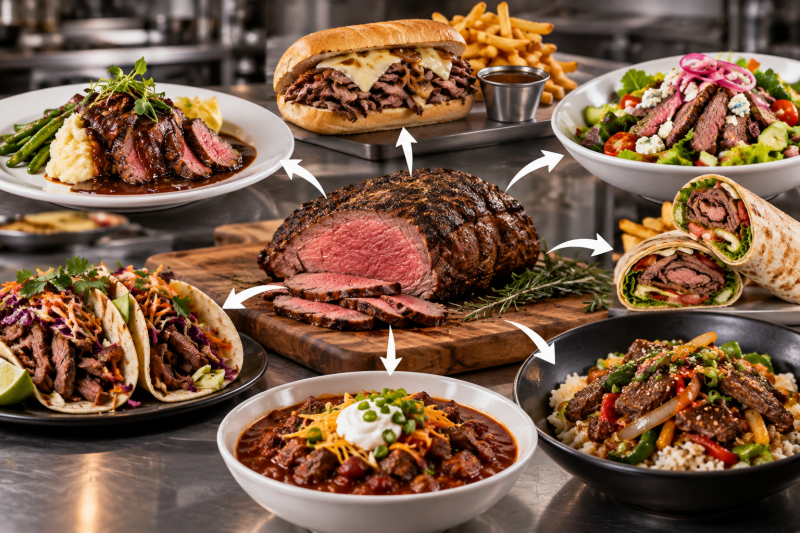
Consider a single cut of beef.
Depending on its suitability, it might be used for steak sandwiches, sliced beef salads, and selected entrée presentations.
Different preparation methods, sauces, accompaniments, and presentations can create distinct dishes.
The key is thoughtful menu development.
I would never recommend adding an ingredient to several dishes simply because the restaurant already has it.
Each dish must make culinary sense and appeal to the customer.
Cross-utilization should support the menu, not dictate every item on it.
9. An Example of Cross-Utilization in Practice
Consider a restaurant developing the following menu items:
Core ingredient
Possible menu applications
Chicken breast
Piccata, Parmesan, Caesar salad, grilled sandwich
Mushrooms
Marsala, steak topping, burger, omelet
Fresh spinach
Salad, sautéed side, omelet, pasta
Mozzarella
Chicken Parmesan, flatbread, Caprese salad
Marinara
Pasta, meatballs, chicken Parmesan
Lemons
Seafood, Piccata, dressings, cocktails
Six core ingredients can support numerous dishes.
Of course, the restaurant will need additional ingredients to complete those recipes.
But the important point is that these core products have multiple opportunities to generate sales.
This approach also creates opportunities to use ingredients across lunch, dinner, and brunch menus.
10. Build the Menu Around Profitability and Demand
Cross-utilization works best when combined with menu engineering.
Before finalizing the menu, I would evaluate several questions:
- Which dishes are likely to be the strongest sellers?
- Which ingredients can be used in multiple dishes without compromising quality?
- What products have the shortest shelf life?
- Which items require excessive preparation labor?
- Can several dishes share a base sauce, vegetable, cheese, or protein?
- Are we purchasing specialty ingredients that will move too slowly?
- Will the menu be practical for the kitchen to execute during peak business?
The answers should influence menu development before recipes are finalized and prices are established.
Once the restaurant opens, actual sales and inventory data should be used to adjust those decisions.
11. Don't Forget About Daily Specials
Daily specials can provide another opportunity for intelligent ingredient utilization.
Suppose a restaurant uses fresh spinach in several regular menu items and has additional inventory approaching its planned use-by date.
A properly planned spinach and mushroom pasta special might be an attractive option.
But specials should not become a dumping ground for unwanted ingredients.
They must meet the same quality standards as the regular menu, and every ingredient must remain within its safe shelf life.
A special should be something the restaurant is proud to serve.
Key point about specials. In a rare case items should be purchased especially for specials.
Specials should be made from in house items and scraps and waste from the preproom.
Bringing in special items for specials only produces stale items left in the refrigerator. The additional dollars just add up and often thrown away.
Rely on the chef, cooks, management and staff to share creative thoughts and ideas.
12. The Menu Should Be Designed for the Kitchen as Well as the Guest
A successful menu needs to accomplish several things at once.
It must attract customers, offer variety, generate profitable sales, and be practical to execute.
Too often, operators focus entirely on what the finished menu will look like to the guest.
But the menu also determines purchasing requirements, inventory levels, preparation labor, storage needs, and kitchen organization.
Those decisions affect profitability every single day.
This is why I believe menu development should begin with a careful evaluation of ingredients and how they can work together.
Final Thoughts
Throughout my years in restaurant management, I learned that profitability often comes from the decisions made long before the first customer walks through the door.
A well-designed menu isn't necessarily the one with the most selections.
It is the one that offers the right selections, uses ingredients intelligently, maintains quality, and allows the kitchen to operate efficiently.
Cross-utilization can reduce waste, simplify purchasing, control inventory, improve consistency, and lower unnecessary labor.
And when done properly, the customer never has to know how efficiently the kitchen operates.
They simply enjoy a great meal.
My philosophy is simple: Before you write your menu, know what you're buying, how you're preparing it, and how many different ways those ingredients can work for you.
PDM Hospitality Consulting
Practical Experience. Practical Solutions. Real Results.